More-balanced fare adjustment
Updated: 2013-04-04 07:51
By Raymond So(HK Edition)
|
|||||||


Five years ago, when the merger of the Kowloon-Canton Railway (KCR) and Mass Transit Railway (MTR) was conducted, the merged railway was operated by the MTR. To facilitate the merger, the MTR introduced one-off fare concessions of more than 10 percent.
On top of this concession, the MTR also implemented a direct drive fare-adjustment mechanism, which allows the company to adjust its fare each year according to a formula. According to this formula, salary increases in the transportation sector and inflation are taken into account. If the calculated fare adjustment hits a threshold, the MTR has the right to increase its fare. This Fare Adjustment Mechanism (FAM) was supported by lawmakers five years ago. However, as Hong Kong's economy moved from deflation to inflation, FAM figures continued to trend upwards. As a result, the MTR is able to increase its fare year after year. Given the MTR is earning billions of dollars, the increase in fare has become a hot social issue.
From the MTR's viewpoint, the FAM is a part of a legal document the company reached with the government. A responsible management should fight for the benefits of the shareholders. Given the fact that the FAM is a binding document, management of the MTR has to work according to the FAM. In other words, no matter how uncomfortable the society is with the fare increases, the MTR still has to go ahead with the increases.
Many critics suggest that the government should exercise its influence in the management of the MTR by virtue of its 76 percent shareholding. However, as the MTR is a listed company, it cannot be solely influenced by the government. Also, the government agreed to be a dormant shareholder when the MTR was first listed. If the government changed its role it will create more disagreements. Hence, the MTR fare adjustment issue cannot be resolved under the current setup.
Nevertheless, it does not mean that the government should do nothing. Increases in MTR fares can become a source of social discontent and the government needs to tackle this issue. The FAM is due for renewal and review this year, and there has already been a great deal of social expectation that the fare adjustment should be more "fair." I used quotation marks in the word fair because the expectation is that the fare should be adjusted downward.
However, this request is more sentimental than rational. When we look at the formula more carefully, the resultant figure is calculated by changes in salary of the transportation sector and inflation. Both figures make sense at first glance. If the society is experiencing salary increases and inflation, it is logical to have the MTR increase its fare according to these trends.
The tricky parts lie in the fact that many MTR users do not have salary increases that match inflation figures. Also, as mentioned above, the MTR is making billions of dollars of profit. When a company is making so much money, no matter how strong the legal grounds is, the public will not accept the fare increases.
Hence, in future revisions of the FAM, consideration should be given to the amount of profit the MTR is making. The general consensus is that there should be a preset threshold. If the MTR profit surpasses the threshold, then the company should not be able to raise its fares. A more complicated formula may also be necessary. Variables like salary increases of the general public, rather than those of the transportation sector, can be considered. The idea is to include more variables in the FAM, so the new one becomes more acceptable to the general public.
Nevertheless, one must be cautious not to have reverse discrimination on the MTR. The new FAM should not target fare reductions, as many legislators want. The new FAM should be transparent and direct driven, so that the MTR and the general public don't experience ambiguities over how the fare is adjusted. We must balance the benefits of both sides. At the end of the day, the MTR is a listed company and the company needs a reasonable level of profit. We should not expect the MTR to make a loss just for serving Hong Kong people.
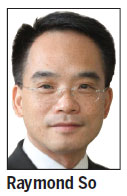
The author is dean of the School of Business at Hang Seng Management College.
(HK Edition 04/04/2013 page11)