From 'steak house' to soul of Portuguese fine dining
Updated: 2012-12-14 07:40
By Andrea Deng(HK Edition)
|
|||||||


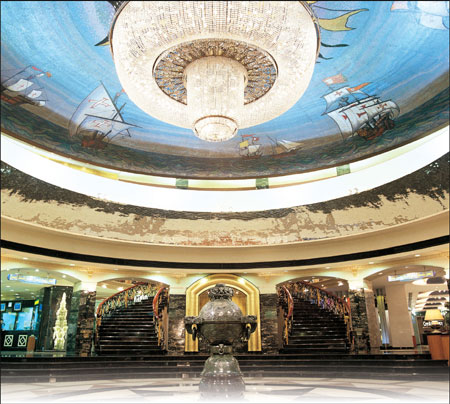
Hotel Lisboa is on a culinary adventure, exploring and developing Portuguese fine dining while and nurturing the cuisine's authentic soul.
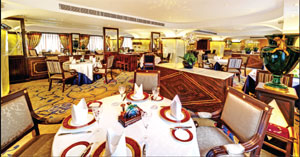
Guincho a Galera, Hotel Lisboa's new Portuguese restaurant launched in January, has been gaining fame in southern China. It stands as this year's fashion statement for Hotel Lisboa, revealing an ambition to cultivate the next Michelin star.
But it has not been an easy task even though the hotel group does have an enviable record of creating and managing Michelin-starred restaurants. The Michelin-starred Fortaleza do Guincho in Portugal under the same hotel group provides French cuisine that has been nicely blended with unpretentious Portuguese flavors. Robuchon au Dme, a three-Michelin-star restaurant formerly known as Robuchon a Galera and now relocated to Grand Lisboa, serves up exquisite French food.
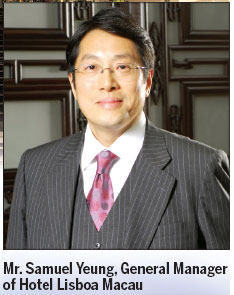
Hotel Lisboa had a history of serving Western food during its early years in the 1970s. Samuel Yeung Chun-yip, general manager of the hotel, recalls how customers in those days used to call the restaurant simply a "steak house". The idea of developing a specialized cuisine took hold about eight years ago while the idea of an authentic Portuguese restaurant was conceived about three years ago.
"There was a market for Authentic Portuguese Cuisine, but there was no such restaurant here in Macao," Yeung tells China Daily.
To gear up for the plan, the hotel sent the chef - who was already skilled in Portuguese gastronomy - along with a team to Fortaleza do Guincho for six months of training to hone their skills and broaden knowledge of traditional Portuguese dining.
It was one of the many basic steps leading to a subsequent brainstorming and exploration of a concrete direction for authentic Portuguese fine dining.
"(The question of) how to preserve the characteristics of Portuguese cuisine while reaching the standard of superlative fine dining has been our focus," Yeung says. "Portuguese cuisine uses a lot of boiling and stewing. There are many household dishes and they usually have a very strong flavor.
"We (also) had to think about the way to interpret the soul of the cuisine at a fine dining level, making it savory without getting people to feel that all the dishes were either boiled or stewed."
The secret, Yeung says, is cooking gravy with raw ingredients rather than artificial flavor; in other words, using two sets of ingredients to cook one dish.
For example, in a household Portuguese dish like Carne de Porco Alentejana - roasted black pork with clams - the gravy retains the flavor of the ingredients while the pork is perfectly tender and juicy since the meat does not have to be overcooked and lose its luster for the sake of the gravy.
"Basically, we use one set of ingredients to cook the flavor of the gravy, the other set to (ensure that) the texture of the food (is good). We adopt this method in many dishes, using Portuguese wine, Portuguese cheese, Portuguese sausage, Portuguese olive oil, all these ingredients that (enable) a Portuguese (to) instantly tell whether they're authentic or not. And that is why the cost of the food is so high," Yeung explains.
In Hotel Lisboa, the philosophy of managing a restaurant in some ways resembles the philosophy of managing the hotel - which is, providing value for money.
The general manager notes that the dramatic changes that have taken place in Macao's tourism industry in recent years exemplify the huge and increasingly growing consumption potential of tourists, particularly those from the Chinese mainland.
Five-star hotels are vying to attract visitors, some providing state-of-the-art MICE (meetings, incentives, conventions and exhibitions) functionality and services, others concentrating on entertainment and stage performances.
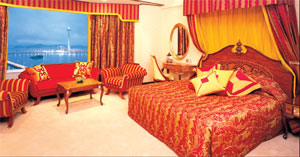
Hotel Lisboa and its mother group, however, want to focus on providing a high-standard eating and living experience, paying minute attention to details. These include handmade matching wooden furniture to produce a more classic European vibe, handmade carpets you sink into while walking on them, and complimentary in-house movies and snacks.
"We want the guests to know that we're professionals in dining - we're striving to get that compliment and notability. We want our guests to really feel that they're on a holiday in a special place, and provide them a fantastic experience that is worth their money," Yeung says.
Hotel Lisboa is looking at ways to stay chic and provide impeccable services to the guests.
"From fine dining to simple congee and noodle cooking, we strive to offer the best. Guestrooms (have different price) ranges, we try our best to cater to different needs. Staffers keep coming in and leaving, we have to continuously provide training to make sure that our service is consistent, and our plans and dreams can be carried out," Yeung says.
"We have always been committed to the best and excellence."

(HK Edition 12/14/2012 page12)