Parents warned about Japanese baby formula
Updated: 2012-08-09 06:57
By Ming Yeung(HK Edition)
|
|||||||


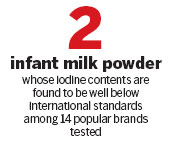
The government has called on parents to stop feeding their babies who are under six-month-old Wakodo and Morinaga milk formulas. The iodine of the two products is well below international standards and authorities fear they could cause irreversible damage to infant development. Iodine deficiency can affect the production of thyroid hormones.
The Centre for Food Safety tested the first group of 14 popular brands of milk powder and discovered that at least six samples had iodine levels below the standard set by codex. Iodine in the two Japanese brands, Wakodo and Morinaga, is less than one-third of the standard.
According to the World Health Organization, the recommended minimum intake of iodine for infants is 110 micrograms a day for infants up to six months and 130 micrograms a day for infants seven to 12 months.
The Controller of the Centre for Food Safety Gloria Tam Lai-fan explained that there is no regulation of iodine concentration in infant formulas in Japan. Japanese women generally produce higher levels of iodine, and can provide infants more iodine than Hong Kong women. Breastfeeding is more popular in Japan. That is the explanation given for the fact that inadequate content of iodine is found only in the Japanese formulas.
To allay concerns of the parents, the Hospital Authority will deploy additional manpower to conduct blood tests on infants aged one to eight months old who have taken Wakodo and Morinaga formulas, at 10 designated maternal and child health centers starting from Friday 6 pm onwards. Parents can start registration today.
Test results of thyroid function will be available in a matter of days. Infants found to be affected by the deficiency will be placed under the care of a pediatrician immediately.
The Secretary for Food and Health Ko Wing-man said on Wednesday that the importers of the two brands have agreed to recall the formulas from the market and will stop selling them.
Ko said the number of affected babies is possibly around 1,000 as these two brands account for only 3 percent of the market.
Spokeswoman for Wakodo said the company had been notified of the result on Wednesday morning and had started recalling the powders. But she said there would not be much stock on the market, since Hong Kong retailers had cut their orders after last year's earthquake and nuclear disaster in Japan.
The importer of the Morinaga brand said the company would follow up on the matter.
Ko urged parents not to worry about babies older than six months, because they can assimilate iodine from other foodstuffs.
The government will complete its testing of 33 nutrients in all milk powders for infants under six months by the end of this year and those for young children aged up to 36 months in the first half of next year, Ko said.
Ko added that the government will speed up legislation to regulate the content and labeling of infant formulas.
Professor of Pediatrics Ellis Hon of the Chinese University of Hong Kong said iodine is essential for mental development in infants. Lack of iodine may lead to mental retardation in infants and children.
Chairman of the Hong Kong General Chamber of Pharmacy Lau Oi-kwok said some problematic Japanese formulas can't be recalled because they are imported directly from the distributor rather than via the agency.
He added that Japanese formulas are mostly sold in tourist districts such as Sheung Shui and Mong Kok to mainland visitors. Hong Kong parents prefer European brands.
mingyeung@chinadailyhk.com
(HK Edition 08/09/2012 page1)