Shanghai: Breaking the dress code
Updated: 2012-07-31 06:51
By Shang Bian in Shanghai(HK Edition)
|
|||||||


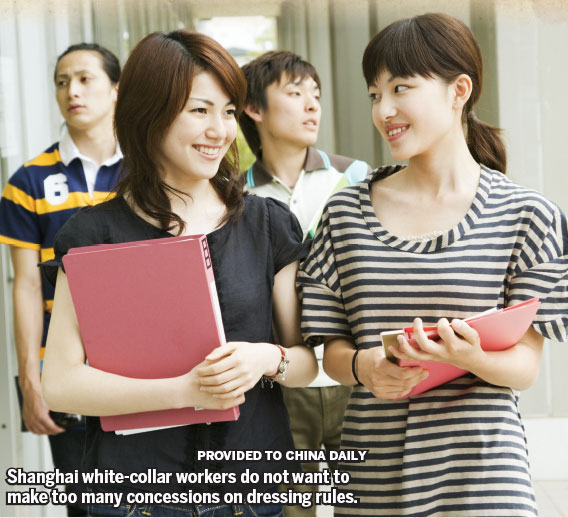
With a black half-sleeve silk blouse, ankle-length jeans and a pair of turquoise peep-toe sandals, Gu Qianyuan went to work last Monday.
"I feel comfortable and decent with them," said this 27-year-old accountant who works for Shanghai Volkswagen. Her office wardrobe is filled with well tailored T-shirts, cotton dresses and skirts falling to the knee. It's a selection that reveals distinctively informal tastes."The dress code in my company is just wear what your supervisor and you like."
Supervisors of Shanghai Volkswagen seem quite tolerant as almost anything including shorts, jeans - even flip-flops are acceptable, according to Gu. "Of course, we are not supposed to wear casual stuff all at once," she said.
For Gu and many other Shanghai white-collar workers, every day is a "casual day". Nearly unrestricted choice of comfortable outfits is gradually gaining approval in many companies, especially during the hot summer months.
"I think wearing suits and ties are really torturous, given the scorching and humid summer climate of Shanghai," said Jing Rongchang, a sales manager at BP Sinopec Joint Venture. "There is no strict dress code unless we need to participate in formal business conferences or visiting local gas stations, when the company uniform is a must."
The dress code of joint ventures like Shanghai Volkswagen and BP Sinopec signals the subtlety of Chinese culture: no written law but everyone knows the bottom line. "Working places are never meant for highlighting one's individuality, no matter in what kind of company," Jing said. "I am glad that my employees never wear too sexy or loose clothes; they don't want to be eye-catching because of clothes."
The situation is no different in state-owned companies, where people adopt either a "self-decided-not-too-informal" dress code or just company uniforms.
"We need to wear uniforms with the bank logo," said Wu Dan, a 50-year-old administrator at the Bank of China, Xuhui sub-branch, "but I am always in my own clothes until I arrive at the office." Preparing two sets of clothes is troublesome, but it does spare her the embarrassment of sweating on the subway in peak hours or going on a date wearing her uniform after work. "It looks ridiculous wearing bank uniforms after work," she said.
Some, however, think the dark and changeless uniforms spare them the pressure and the cash to keep up with the office trend. "At first I also complained bank uniforms make me look old, but now I find it's good not to pay attention to what I should wear, just the work," said Wang Di, a 28-year-old financing manager of Agriculture Bank of China, Shanghai branch.
To be sure, foreign companies in Shanghai still prefer more formal dress code, but business casual is a developing trend.
"We have business casual from Monday to Thursday, which means no sleeveless tops, shorts, jeans or flip-flops, just the same as most foreign banks and consulting firms worldwide," said Chen Baihua, a global treasury advisor of Overseas-Chinese Banking Corporation Ltd, "But the standard is not that strict." She thinks a nice knit shirt is necessary in the forever 20 degree temperatures in buildings around the Lujiazui financial center, Pudong. "Formal dress doesn't always lead to the fading away of personal taste," said Chen. "I see more vivid colors and shining accessories in summer."
However, not every employee wants to make too many sacrifices for company rules. "People shouted that 'this is not a dress code reminder; this is new' the moment we got the email from HR," said Zhang Dongliang of Jigsaw Market Consulting Shanghai Co, Ltd. "She informs us to have no jeans, no sleeveless or collarless tops for men and the no-no's are even more for women."
Zhang thinks the regulations too detailed to be reasonable. "My colleagues replied to her via the company e-mail system so everyone can see it, complaining 'The old curtain in my apartment can be used again', or 'For those looking, there's a Hillary Clinton collection from K-Mart'," he said.
"I think strict dress codes don't always do well for a company," said Bernard Wong, a Singaporean vice president of Lubrizol, US chemical products companies, in Shanghai. "Sometimes, different dress styles can show individuality and inspire employees' creativity." Wong said professionals just avoid any attire they feel very comfortable wearing to the beach, too sexy hot pants, miniskirts or clothes for going to the wet market. "Of course the borderline of these taboos are judged more on personal feelings," he admitted.
Energy saving is another concern. Shanghai civil servants don't wear suits and ties except for attending foreign affairs in summer as the indoor temperature should be kept above 26 degree Celsius, according to a regulation issued by the State Council in 2008. "Mini-skirts and flip-flops are not allowed in government offices but formal suits overdo things," said Wang Jiangnan who works for the government of Hongkou District, Shanghai. "It can save a lot of energy and money during the electricity peak every summer."
Wang doesn't think there is a necessary connection between formal suits and civil servants' performance. "But we are at least supposed to look dignified," she said. "After all we stand for the government."
Zhou Qinnan contributed to the story.
shangbian@chinadaily.com.cn
(HK Edition 07/31/2012 page4)