Consumer confidence on the wane as wage law sparks job worries
Updated: 2011-03-16 07:17
By Joy Li(HK Edition)
|
|||||||


Nielsen survey shows low-income groups worried about layoffs
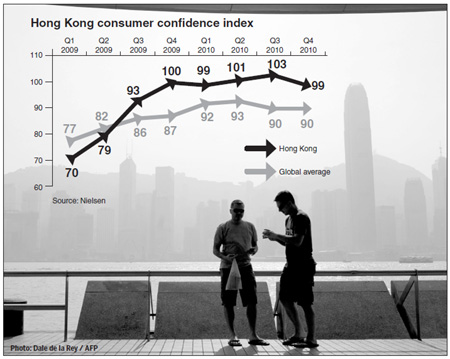
Consumer confidence in the city dipped in the fourth quarter of 2010, mainly driven by a drop in optimism about job prospects due to the upcoming implementation of the minimum wage law, according to a Nielsen survey released Tuesday.
The latest Nielsen Company's Global Consumer Confidence Index found a drop of 4 points to 99 points in the fourth quarter of 2010. According to the survey, 55 percent of respondents said they are optimistic about job prospects, down from 62 percent in the third quarter of 2010.
"Although the unemployment rate in Hong Kong decreased to 3.8 percent, the minimum wage law to be in effect from May has raised the concern of the low-income group," said Oliver Rust, managing director of Nielsen in Hong Kong. He added that many are worried that the new law will cause companies to cut costs by laying off staff - thus reducing their job prospects.
The government has set a statutory minimum wage rate of HK$28 per hour, effective May 1.
According to a study taken by the Provisional Minimum Wage Commission - a representative body set up by the chief executive - about 314,600 or 11.3 percent of employees in the city would be affected by such a rate. They will see their wages rising by 16.9 percent while the city's total wage bill will increase about HK$3.2 billion or 0.6 percent to HK$541.6 billion.
Other than employment prospects, consumers are still confident about the state of their personal finances (62 percent) and spending intentions (44 percent) for the next 12 months amid the improving economic environment in Hong Kong, according to the survey.
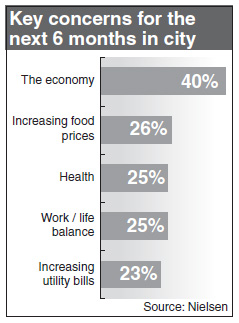
Despite the fact that the local unemployment rate fell to a 27-month low of 3.8 percent in January and the city's economic output grew by 7.2 percent in 2010, people still list the economy (40 percent) as their top concern. Food prices (26 percent) stood as the second biggest concern. Rising raw material costs such as oil have driven food prices up significantly over the past year, said the survey.
"Food prices in Hong Kong have gone up 4 percent on average from 2009, with fresh vegetables (13 percent) and fruits (10 percent) seeing the highest increases. According to Nielsen Homescan, with the fresh food categories being purchased on average of every 2.7 days, consumers are feeling the effects of the price increases," said Rust.
Underlying consumer price inflation rose to a two-year high of 3.5 percent in January on higher rents, food and energy prices.
In the latest Hong Kong Economic Monitor issued by Hang Seng Bank, the bank's economists believe that rising price pressures are coming from both the external and domestic fronts and seem unlikely to stabilize in the near term.
The bank revised up its 2011 real GDP and inflation forecast to 5.5 percent growth and 4.7 percent respectively.
"If oil prices continue to skyrocket for a sustained period of time, it could dampen the global recovery, posing downside risk to our growth forecast," said the Monitor report.
Oil prices have surged 11 percent in New York since January when unrest in the Middle East started to flare up.
China Daily
(HK Edition 03/16/2011 page2)