Government intervention and the minimum wage
Updated: 2010-08-03 07:35
By Hong Liang(HK Edition)
|
|||||||


|
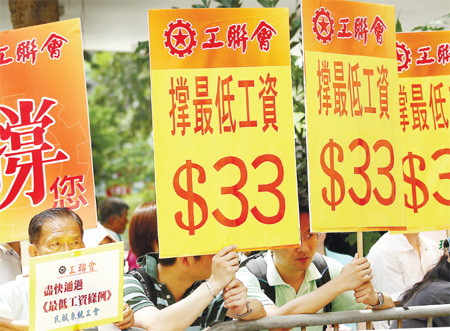
Protestors demanding a minimum wage of HK$33 per hour demonstrate outside the Legislative Council in Hong Kong when lawmakers were debating on this issue. Edmond Tang / China Daily |
With the rather cryptic label of "positive non-interventionism," the Hong Kong government's economic policy has always been seen to be wrapped in an almost mystic aura.
Born out of the social and economic constraints of the colonial era, its validity has been increasingly brought into question.
We're not surprised that the introduction of the minimum wage law has been seen by some local and foreign commentators as a blow to the non-interventionist part of the policy. That may be so, but we believe such intervention is positive and has not in anyway undermined the free market principle that we continue to hold sacred.
In the colonial era before sovereignty was returned to China in 1997, the terms of the lease largely ruled out any form of long-term government debt. Balanced budgeting was a matter of necessity more than choice. Social services were limited mainly to health care and education to ensure that recurrent expenditure was maintained at manageable levels.
What's more, any form of national pension plan would not have jibed with the then prevailing transient mentality of the people who would rather keep the money in case they needed to move on to another safe haven in a hurry. What people of Hong Kong wanted most in those days were low taxes and minimum government meddling with their lives.
But the aspirations of the Hong Kong people are not that simple and straightforward anymore. The "one country, two systems" principle seems to work, despite occasional challenges. This has helped strengthen public confidence in the long-term future of Hong Kong. Such confidence has, in turn, raised the sense of belonging in the minds of many Hong Kong people.
Of course, everyone wants the tax rates to remain low, and any attempt to widen the tax base with the introduction of indirect taxes is met with widespread suspicion. The government has no need to borrow as budget discipline is enshrined in the Basic Law.
But more and more Hong Kong people are expecting the government to take a positive role in addressing perceived social injustices, crystallized in the widening wealth gap between the rich minority and the less-well-to-do majority. To do so could involve the government in the re-distribution of wealth, which goes directly against its free market principle.
In fact, the government has already been deeply involved in the re-distribution of wealth since it adopted the fiscal policy in the late 1970s of financing capital expenditure with proceeds from the sales of government land. The process has led to a massive concentration of wealth in the hands of the property oligarchy dominated by no more than a dozen local developers.
The government has also played a conspicuous role in regulatory reforms that laid the foundation for the development of the financial sector into a major pillar of the Hong Kong economy.
As the government of a developed economy, with a per capita GDP ranking near the top in Asia, legislating a minimum wage is the least it can do to protect the workers with the least bargaining power against exploitation by unscrupulous employers. It is the positive thing to do.
(HK Edition 08/03/2010 page2)