HK and Taiwan investors pursue different targets in Shanghai
Updated: 2010-04-02 06:26
By Xu Junqian(HK Edition)
|
|||||||


|
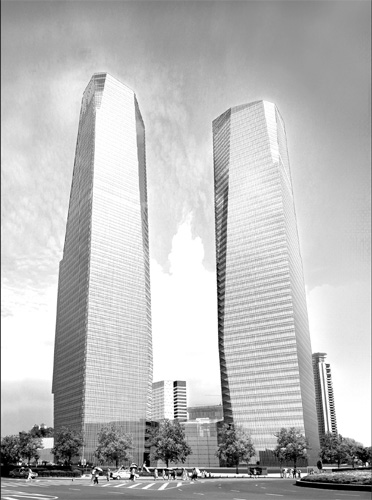
An artist's impression of the International Financial Center Sun Hung Kai is building in Lujiazui financial district in Shanghai's Pudong New Area. Jerome Favre / Bloomberg News |
Late last month, Swire Properties and HKR International, both of Hong Kong, jointly announced that they have entered into an agreement with Bank of China to develop the 8-billion-yuan Dazhongli Project in Jingan District of Shanghai.
The announcement came shortly after another Hong Kong real-estate developer, Sun Hung Kai, said its 6-billion-yuan International Financial Center (IFC) in Shanghai is scheduled to open in the second quarter of 2010 to coincide with the Expo, which will run from May 1 to October 31.
While these extravagant projects are wildly touted by the local media as the onset of a big property rush by Hong Kong developers in Shanghai, the Taiwanese business people are quietly expanding their interests in many other fields, ranging from manufacturing to retail and catering.
Taiwan business people in Shanghai love to boast that they can cater to nearly all the needs of an average mainland consumer from "head to toe." And, of course, that goes for the stomach too.
Some of the best known Taiwan establishments in Shanghai are the restaurant chains specializing in a cuisine that is a mix of Fujian province and native Taiwan, with a dash of Japanese influence. Yonghe, a Chinese fast food chain controlled by Taiwanese interests, is the only such establishment that can give McDonald's and KFC a run for their money. With the unusual name of 85C, the Taiwan bakery with an extensive network of outlets in the city has shot past many of its local competitors to the top spot in popularity among Shanghai bread gourmands.
The latest study by independent market research firm AC Nielson ranks some Taiwanese-brand processed foods top in Shanghai among competing labels. Master Kong from Taiwan has a stranglehold, with more than a 40 percent share of the large instant noodle market in Shanghai.
"Investors from different regions usually focus on different industries in accordance with their unique economic advantage, tradition and industrial structure" explained Zhu Lianqing, director from Commerce Research Center of Chinese Academy of Social Sciences.
"As an open harbor, Hong Kong has always played the role of a financial, trade, and commercial center. Its strength in the real estate industry and support from Chinese government's unrestrictive policy have encouraged Hong Kong property companies to extend their business here," Zhu said.
In the past few years, the major Hong Kong real estate companies, including Shui On Group, Henderson Land and Lai Fung Hold have bought a total of more than 41 million square meters of land on the mainland, mostly in Shanghai and Beijing. This has represented a sharp departure from their past investment strategy concentrating mainly in Guangzhou, Shenzhen and the larger cities and towns in the Pearl River Delta region.
To the big Hong Kong developers, flush with capital, only the markets in Shanghai, and to a lesser degree, Beijing, are big and liquid enough to accommodate the size of the investment without being distorted. As development lands for large projects become scarcer and scarcer in Hong Kong, these developers are increasingly turning their attention to Shanghai, where demand for top-rated office lots is expected to remain strong in coming years, industry sources said. They said they expect the rush of investment capital from Hong Kong into the Shanghai real estate market will continue, despite widespread concern about overheating.
In contrast, Taiwan's investment in Shanghai real estate has remained modest. "There are actually a few properties in Shanghai invested in by Taiwan companies, like the Aurola Tower at the Lujiazui Financial Center, Pudong New Area. But they did not make an industry," said Lu Xiaoyan, general secretary for the Taiwan Business Association.
Taiwan is traditionally strong in manufacturing industry. Some of these companies have taken the advantage of the opening of the mainland market to race ahead of their competitors who were either unwilling or unable to make the cross-Straits leap.
Booming sales in Shanghai and other mainland cities have helped catapult Master Kong to the forefront of Taiwan's food processors ahead of what used to be its much larger rival, Uni-President, which, for reasons beyond its control, was late in entering the mainland market.
"Master Kong is considered the early bird that caught the worm," said Lu. "Many more other Taiwan companies are making the trek to Shanghai looking for a bite of the ever-expanding pie," Lu said.
China Daily
(HK Edition 04/02/2010 page2)