Measures to tackle solid waste and climate change
Updated: 2009-10-30 07:46
(HK Edition)
|
|||||||


Building on the environmental protection initiatives in the past two years, the policy direction of this year's policy address in environmental terms is threefold, Secretary for the Environment Edward Yau told China Daily.
The first is air quality in relation to protection of public health. In July, the government published an Air Quality Objectives review to consult the public, with a view to using the Air Quality Guidelines of the World Health Organization as the goal, he said.
The consultation will expire at the end of November.
|
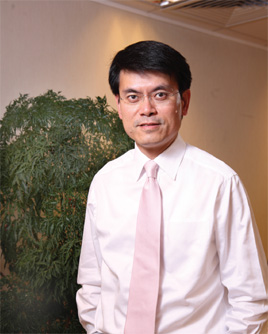
Edward Yau has a green plantation to liven up his office. |
Second, the government will consult the public on a solid waste management scheme, following the largely successful introduction of a levy on plastic bags in July this year.
Yau noted the rate of waste recovery in the commercial sector is quite satisfactory at 61 percent against merely 31 percent for household recoveries.
Particularly, the disposal of electronic products such as computers, mobile handsets and electrical appliances that are still quite new and in useable condition is rather serious in Hong Kong as a wealthy society.
Hoping to tackle the increasing food waste problem, the government will construct a recycling centre in Siu Ho Wan on Lantau Island to convert food waste into useful resources such as compost and biogas.
"The waste management scheme cannot be more pressing as we can no longer rely on landfills alone to deal with solid waste, and we need to decide on a suitable site to build incinerators next year," Yau said, adding that Hong Kong is trailing Guangzhou and Shenzhen in the use of incineration technology.
Climate change is another important issue that the government needs to address, said the environment minister.
In Hong Kong, 63 percent of the greenhouse gas emissions come from power generation against 16 percent from vehicle emissions. As to emissions from power generation, 89 percent come from buildings, i.e. power consumption from use of air-conditioners, lighting and elevators.
"There is a need to have a minimal energy efficiency standard in Hong Kong," he proposed.
Although there is an energy efficiency code in force and over 1,000 buildings are practicing this code, it is not legally-binding while 75 percent of these buildings are government buildings.
"In this connection, the government is going to enact an energy efficiency law that requires all buildings to comply with. We will introduce a bill into the Legislative Council by the end of the year. The law will cover residential, commercial or industrial buildings, although different standards will apply," Yau said.
The law will not only apply to new buildings, but also old buildings that undergo renovation, he added. As to the energy efficiency standard, it is hoped that everyone can meet it; accordingly, it will not be set too high.
As an initiative of the 2009-10 Budget, the HK$4.5 million dollar-for-dollar matching fund for enterprises to carry out carbon audits is working well. Since April this year, some 850 applications have been received.
Taking the Ming Pao newspaper as example, he was aware that the company spent about HK$56,000 for a carbon audit and installation of energy-saving equipment. As a result, it achieved a half-million dollar savings in its electricity bill over six months.
Yau further hailed the recent initiatives that promote the use of clean fuel in Hong Kong. While the construction work of the Second West-East Natural Gas Pipeline commenced in February, energy companies on both sides have renewed an agreement on supplying nuclear power for an additionial 20 years.
"If we follow the path of energy efficiency, together with less power consumption and use of cleaner fuel, Hong Kong will become a much better and cleaner place to live in," the environment minister pledged.
Asked if he can finish the numerous mammoth tasks before his term expires in July 2012, Yau did not underestimate the difficulties ahead of him.
Saying that environmental protection involves concerted efforts of government and society, he will not adopt a "cherry-picking" mentality by doing only the relatively easier things and avoiding the tough jobs.
At the same time, he also called on the public not to adopt the "not in my backyard" mindset with regard to construction of environmental protection facilities in local communities.
(HK Edition 10/30/2009 page4)