Show illustrates 70 years of art portraying life in New China


The Tian'anmen rostrum in Beijing has undoubtedly been a more popular spot than usual over the past few days, as crowds of visitors have poured into the famous square to take pictures of some of the floral and poster decorations that are still on display from the grand parade that was held on Oct 1 to mark the 70th anniversary of the founding of the People's Republic of China.
The rostrum has been the subject of many artworks that symbolize national unity and hail New China's achievements over the decades.
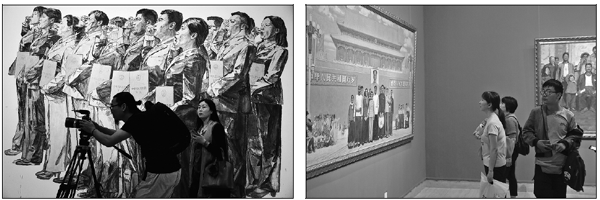
In Front of the Tian'anmen Rostrum, a 1964 oil painting by the late artist Sun Zixi, depicts groups of people taking photos with the rostrum. He employed the style and the palette of traditional Lunar New Year prints to deliver a joyful feeling that has ensured the work is still well received today.
In 2009, Tang Yangli, a professor at the Central Academy of Fine Arts in Beijing, created Birth of New China using colored ink on paper. The piece portrays leaders and guests on the Tian'anmen Rostrum at the grand ceremony on Oct 1, 1949. The work reminds many people of Founding Ceremony, an oil painting with the same theme by late artist Dong Xiwen. In his 8-meter-long scroll, Tang blended the meticulous gongbi style of classic Chinese painting, the figurative techniques of oil painting and the highly decorated patterns of the Dunhuang murals to create a unique portrayal of the famous event.
The two paintings by Sun and Tang, both from the collection of the National Art Museum of China in Beijing, are now on show as part of Great Journey, Splendid View, an exhibition that runs through Nov 2 that allows visitors to review the accomplishments of New China through the evolution of Chinese art over the past seven decades.
While many of the works on show are from the National Art Museum's collection, some are on loan from other galleries and the artists themselves.
Wu Weishan, director of the National Art Museum of China, says the exhibition is a rare opportunity for people to see a great number of China's iconic artworks created since 1949 in one place.
"The forms range from Chinese paintings, oil paintings, lithographs, sculptures to watercolors, traditional Chinese folk art and posters. There are nearly 500 works in total, occupying all of the exhibition halls inside the museum, as well as the outdoor space of the museum's compound," Wu says.
"It is a tribute to the history, the landscapes and the people, who have made contributions to the country. Also, it reflects and concerns the livelihoods of common people."
Changes in the way people have been depicted in Chinese art can be seen at this exhibition. Works from the 1950s and '60s mainly portray scenes of busy workers on the construction sites of major industrial projects or farmers laboring in the fields, showing a country's strong will to develop and eliminate poverty.
In the 1980s, more scientists began to appear, indicating the increasing importance of science and technology after China's reform and opening-up.
These days, however, artists focus on the twists and turns in the day-to-day lives of the country's people, such as migrant workers from rural areas and delivery people, who play a noticeable role in urban society.
Chen Lyusheng, a senior researcher at the National Art Museum of China, says when looking back the progress of China throughout the past seven decades, one will also find that "landscapes that depict industrial construction have been favored during different periods".
He says the artworks were created to address the country's needs at the time. For example, many of the works from the 1950s and '60s depict steel making at factories to reflect a boom in the industry. The completion of the Nanjing Yangtze River Bridge in the late 1960s created a fashion among artists to portray the bridge and other similar projects in the 1970s. He adds that, as Chinese cities have experienced rapid urbanization since the 1980s, art depicting the country's cityscapes has risen, creating a new genre that explores the feelings of city dwellers surrounded by high-rise buildings and overpasses.
linqi@chinadaily.com.cn
|
The National Art Museum of China in Beijing is hosting Great Journey, Splendid View, an exhibition that allows visitors to review the accomplishments of New China through the evolution of Chinese art over the past seven decades. Photos by Jiang Dong / China Daily |
(China Daily Global?10/09/2019 page15)