Moo-ving back into China
 |
|
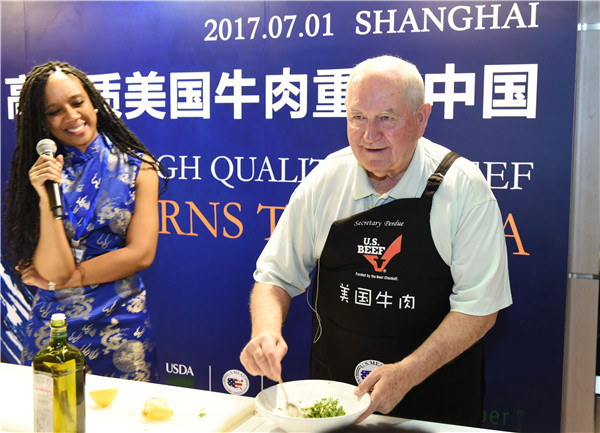
Sonny Perdue, US secretary of agriculture. [Photo provided to China Daily] |
Appetite for beef
Per-capita consumption of beef in China, where pork is the most popular choice of meat, has doubled from 2.8 kilograms per year at the beginning of the century to 5.45 kilograms in 2015.
While this amount is small compared to the global average of 6.6 kilograms, the US Agriculture Department has projected that China will this year overtake the European Union as the world's second-largest consumption market for beef, after the US where per-capita consumption is 25.27 kilograms.
Last year, people in China consumed 8 million tons of beef with a market value of 360 million yuan, according to China's Ministry of Agriculture. Domestic beef production rose to 7.17 million tons in 2016, a 2.4 percent year-on-year increase. A demand-supply gap of 830,000 tons is still waiting to be filled.
Before the ban, US beef had a significant market share in China. According to The Observatory of Economic Complexity, US beef accounted for 44 percent of China's total beef imports in 1999. In recent years, Australia and Brazil have become the main sources of imported beef in China, which is currently the world's second-largest beef importer after the US.
Restaurants and hotels in China like Morton's of Chicago and Park Hyatt say they plan to promote US beef soon. But industry players say that the return of US beef is unlikely to reshape the current landscape or oversaturate the market.
"The market is too large and demand is still more than supply. Besides, its high price has restricted it to a very niche group of consumers," says Yang Yiyi, vice-president of Yiguo, a fresh produce e-commerce platform headquartered in Shanghai.
Backed by Alibaba Group Holding Ltd, Yiguo is one of the first two domestic e-commerce retailers to sell US beef in China. The other is Womai.com, an online platform run by the country's largest food trader, China National Cereals, Oils and Foodstuffs Corp.
According to the new trade deal, US beef exported to China must come from cattle no more than 30 months old and be free of any hormones, ractopamine and other chemicals prohibited by Chinese law.
Xu Shangzhong, chief of the China Cattle Industry Association, points out that less than 10 percent of the total beef production in the US meets these stringent criteria.