Currying flavor south
 |
|
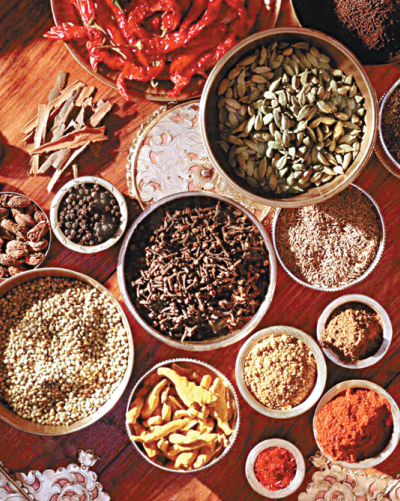
An array of spices that are often used in Indian food. [Photo by Tu Weimei/China Daily] |
A fragrant trail of seeds and leaves
The spice trade reached a frenzied peak in the era of the Silk Road. But such commerce in cinnamon, cassia, cardamom, ginger, pepper and turmeric is documented between historical civilizations of Asia, northeast Africa and Europe back to ancient times.
India's southwest state (province) of Kerala had established itself as a major spice trade center as early as 3000 BC, which history generally considers the beginning of the business. Indian spice exports are mentioned in the works of ancient seafarers such as Ibn Khordadbeh, al-Ghafiqi, Ishak bin Imaran and Al Kalkashandi. The seventh-century Chinese traveler and monk Xuanzang mentions the Indian town of Puri on the Bay of Bengal, where "merchants depart for distant countries".
India's legendary curry (and curry powder) is not a single spice but a blend of many, which can vary in different regions of that country and even more in places where spice traders took it abroad, such as Malaysia and Thailand.
There is, however, a curry tree-and the resulting spice sets South Indian dishes apart. The curry tree (Murraya koenigii) has fragrant leaves that are also prized in Sri Lankan cooking. In both countries, the leaves are usually fried with chopped onions in the first stage of a curry's preparation. In their fresh form, they have a short shelf life, even in the refrigerator. Dried leaves last longer, though many chefs pooh-pooh that option as the aroma is second-rate.
While leaves from the curry tree are most commonly used in curries, they can add flavor to many other dishes. In Cambodia, for example, Khmer people toast the leaves until crispy and then crush them into a sour soup called maju krueng.
Overland routes stimulated the spice trade initially, but the development of sea lanes led to tremendous growth in commerce. In the earliest days, traders successfully kept secret the source location of the spices, often associating them with fantastic tales such as Sinbad the Sailor.
Much later, Portuguese colonial settlements saw traders such as the South Indian Chettis, Chinese from Fujian province and Arabs from Aden involved in the spice trade. Indian traders took their cuisine to Southeast Asia, notably present-day Malaysia and Indonesia, where spice mixtures and curries remain popular.