Tea gone wild
 |
|
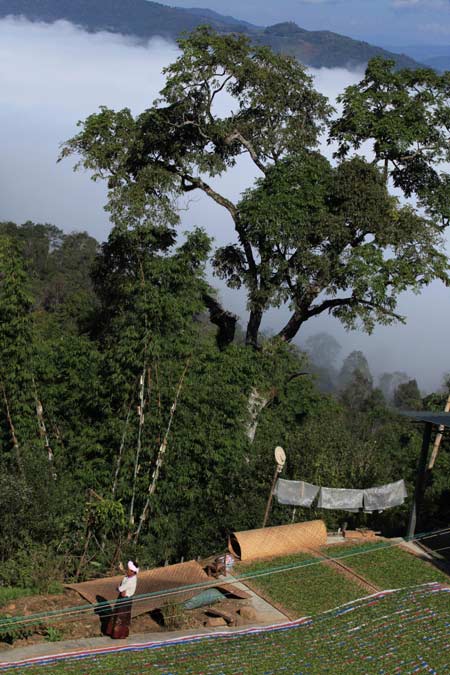
A tea farmer dries the newly harvested tea leaves from wild tea trees in Yunnan province. [Photo by Zhang Jing / For China Daily] |
|
|
|
|
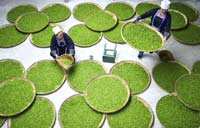
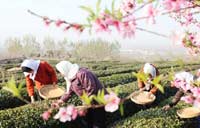
The rolling hills where these two families have resided for generations are the birthplace of tea and are the origin of the southern Ancient Tea-Horse Road, a business bond that connected Yunnan's tea to the rest of China and the world beyond.
More than 180,000 aged trees, including 500 trees more than 500 years old, are still scattered in that region. The tea that is made from their leaves is called pu'er.
Pu'er is no new name for tea lovers. Some promoters call the aromatic beverage a wonder tonic that reduces cholesterol and lowers blood pressure. Some see it as the "soft gold". And some compare it to Western wine-the older the better.
The excitement for pu'er tea from Yunnan from 1999 to 2007 drove the prices up tenfold, to a tipping point of 17,000 yuan a kg for the finest aged pu'er, before collapsing far below its pre-boom levels.
But right after the boom and its aftermath, the urban sipping class narrowed its attention to the wild pu'er tea from trees at least 300 years old.
"The tea from the ancient trees has a mellow aftertaste. Rare and nutrient-rich, it is difficult to obtain from the tall, gnarled trees in the mountains," says Dong Zi, president of Kunming Gu Cha Fang Tea Industry Co. "And it's completely pesticide-free."
"People say you can get drunk from drinking (industrial) tea, but insiders know that you are actually 'drunk' from consuming too much pesticide residue," says Tong Xiaofeng, who has sold wild tea from Yunnan for almost five years in Beijing. "That's why some customers began to seek something natural."
There are three major wild-tea production areas in Yunnan: Xishuangbannan, Pu'er and Lincang. The famous brands' average prices per kg range from Iceland's 20,000 yuan, and Banzhang's 8,000 yuan to Jingmai's 1,500 yuan.