Crazy about hotpot
 |
|
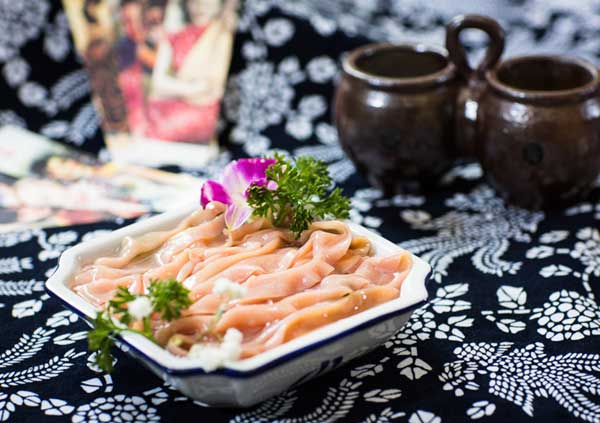
A wide variety of ingredients like duck intestine (above), mutton, beef and tofu can be cooked in Chongqing hotpot. |
Nie runs a hotpot business that includes chain restaurants and ingredient factories. He quit his job at a State-owned enterprise in the 1990s to start a small hotpot restaurant with six tables. That small restaurant grew into a successful business.
"I benefited from hotpot, now it is time to give something back," Nie says.
|
|
| Taste of home |
|
|
| Crustacean sensation |
Although there is no hard evidence as to where the birthplace of spicy hotpot is, Nie, as the director of the Chong-qing Hotpot Research Center, believes Chongqing hotpot originated from the porters' cuisine in late 19th century.
Chongqing is a port city along the Yangtze River. In the late 19th century, live animals from Sichuan, Guizhou and Yunnan provinces were shipped by water, killed, sold or preserved in Chongqing's port. Good meat was shipped and sold to the upper and middle classes. The internal organs, including stomach and kidney, were discarded or sold cheaply. Porters picked up or bought the organs and cooked them in a boiling pot with spicy sauce and ate it by the water.
Two brothers with the last name Ma happened to taste the street dish and were hooked. They saw a business opportunity and introduced the dish into their restaurants in the 1930s.
Nie believes the first hotpot restaurant is Ma Zheng Xing, owned by the Ma brothers.
A pot from Ma Zheng Xing Restaurant is located on the third floor of the museum.
Novelist and scholar Li Jieren (1891-1962), native of Sichuan province, agreed with Nie, and stated that the origin of spicy hotpot was Chongqing in his magazine, Feng Tu Shi Zhi, an important folklore magazine in the 1940s.
In the magazine, Li also writes about the evolution of spicy hotpot. When Chiang Kai-shek's Kuomintang government established Chong-qing as China's capital in 1937, the city attracted many new residents who fell in love with spicy local dish.
According to Li's article, many elites were hotpot fans.
Dai Li, the head of Chiang's military intelligence service, was a fan of hotpot and always hosted hotpot feasts for financial tycoons.
Although these people left Chongqing after the war, they took their love of hotpot with them and the cuisine's popularity spread.