Comments
  Print
Print  Mail
Mail  Large Medium Small
More than one third of Chinese babies have sleeping problems, and inappropriate parenting behaviors contribute to such problems, a recent survey indicates.
The report was released in September by the National Center for Women and Children's Health under Chinese Center for Disease Control and Prevention, based on a three-year survey and one-year statistical analysis.
It found many Chinese parents making mistakes that are destructive in developing the babies' healthy sleeping patterns.
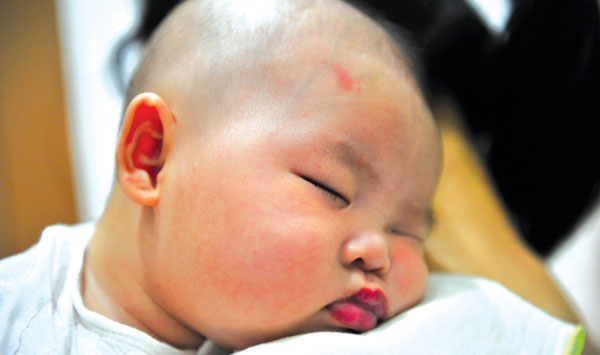
For example, the survey found that most Chinese babies fall asleep while parents hold, pat and feed them - which should be discouraged. Some even need companions or toys to fall asleep. Parents should let the babies fall asleep by themselves.
|
A new survey finds many babies fall asleep while parents hold, pat and feed them, which experts say should be discouraged. Provided to China Daily |
Besides, the majority of the babies are put to bed only when they have fallen asleep completely, and few are put to bed when they are sleepy or awake.
Most noticeably, many babies sleep in their parents' bed, and the rate rises as babies grow. Only few have their own beds or rooms.
"Parenting behaviors influence babies' sleep, and bad sleep can harm the physical, emotional and cognitive development of babies," says Huang Xiaona, a researcher involved in the survey.
"We have found that giving babies a bath before bed time, putting them to bed before they fall asleep, using paper diapers and avoiding sleeping in the same bed with them help babies sleep better."
But many parents are doing it wrong, and the CCDC hopes a direction brochure for parenting developed after the survey will be helpful and instructive to families with babies, Huang adds.
The survey launched in 2009 in 10 urban hospitals nationwide. It collected statistics on sleeping patterns, physical and mental development of about 500 babies under 1 year old since they left hospitals, both through parenting diaries, and data-collecting devices, such as wrist watches.
"The survey is the first of its kind in China that has both subjective description from parents and objective data collection through intelligent devices on a large scale and over a long period," says Wang Huishan, director of the children's healthcare department at the National Center for Women and Children's Health.
"We analyzed the statistics with the help of Procter & Gamble scientists for better accuracy," Wang adds.
According to the survey, about 30 to 40 percent of babies have sleeping issues, including having difficulties falling asleep again if they wake up during night.
Additionally, the younger the babies are, the more likely they are affected.
The survey reaffirms that as babies grow, they tend to sleep less during the day, and also wake up less at night.
Liu Xicheng, a specialist of childhood sleeping disorders with Beijing Children's Hospital, says the figure in China is higher than the world statistics, which found only 20 to 30 percent of babies have sleeping problems.
Related:









Feline-themed cafe a hit in French capital |

Heilongjiang now top 'green' food grower |

Tibetan herbs enrich local people |

Gourmet festival opens in Beijing |



Grape harvest season in France |

China greets harvest days for autumn crops |

'Masticar' gastronomic fair held in Argentina |
Farmers pick autumn tea in C China |

Disney's new heights |

My Son's secrets |

Buy, buy in Bangkok |

A thousand trades, a thousand tales |
Copyright 1995 - . All rights reserved. The content (including but not limited to text, photo, multimedia information, etc) published in this site belongs to China Daily Information Co (CDIC). Without written authorization from CDIC, such content shall not be republished or used in any form. Note: Browsers with 1024*768 or higher resolution are suggested for this site.
License for publishing multimedia online 0108263 Registration Number: 20100000002731