World's first laboratory-grown beef burger
 |
|
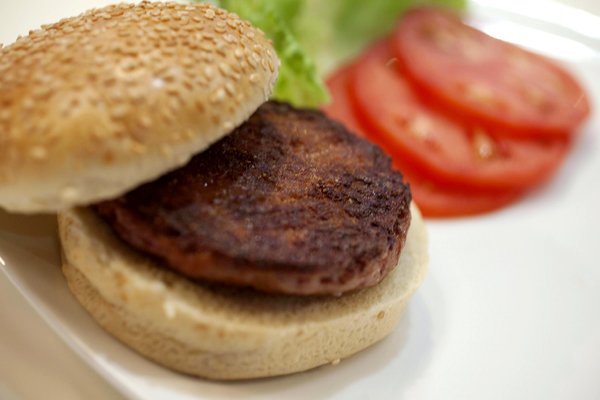
The world's first lab-grown beef burger is seen after it was cooked at a launch event in west London August 5, 2013. [Photo/Agencies] |
The world’s first laboratory-grown beef burger has been flipped out of a petri dish and into a frying pan, with food tasters declaring that it tasted "close to meat". Experts say new ways of producing meat are needed to satisfy growing carnivorous appetites without exhausting resources.
It cost a mouth-watering quarter of a million euros to make and wasn’t produced like any other burger - it was grown in a test tube by Dutch scientist Mark Post.
"We take a few cells from a cow, muscle specific stem cells that can only become muscle. There’s very little we have to do to make these cells do the right thing. They divide by themselves and if we provide those anchor points for future tendons they will self organize into muscle. So a few cells that we take from this cow can turn into ten tons of meat," said Post, Professor of Physiology at Maastricht University.
Each burger is made from 20,000 strips of meat. It’s mixed with beetroot and saffron for colour and egg, breadcrumbs and salt for flavour and texture.
"I was expecting the texture to be more soft, there’s a real bite to it and the browning gave it some flavour. It’s close to meat but not that juicy," said food scientist Hanni Rutzler.
The project at Maastricht University was originally started as food for astronauts. It was funded by the co-founder of Google Sergey Brin.
"We have a vision in our minds of this pristine farm, a couple of cows, some chickens, but that’s not actually how meat gets produced today. When you see how these cows are treated it’s certainly something I’m not comfortable with," Brin said.
Meat consumption is expected to increase by more two thirds by 2050. That’s a problem for the planet, says Morgaine Gaye, a food futurologist.
"Animals create a lot of methane. They create a lot of greenhouse gasses. They’re taking up a lot of farmland which could be used to grow vegetables and grains which would feed a lot more people, so we know that meat really is an expensive commodity on every level," Gaye said.
The UN’s Food and Agriculture Organisation estimates the meat industry is responsible for almost a fifth of global greenhouse gas emissions.
It could also mean an end to global food shortages. "We have the tofus, the tempais and the corns right now on the supermarket shelves. Things that really were the offshoots from the TVP, textured vegetable proteins of the 70s, and we’ve come a long way since then in 30 years, and I think that the invitro meat will have a place within that array of meat type products," Gaye said.
Post believes commercial production could begin within 20 years. And any distaste could easily be overcome if the product is cheap enough.