Sweet success
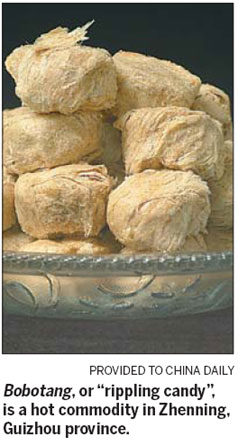
Passing the highway toll station to enter Zhenning county, Guizhou province, we see a billboard advertising bobotang, or "rippling candy".
"The county is soaked in the fragrance of candy," our guide says.
I am not a fan of sweets but after first tasting this crispy sesame-coated candy, I could not resist another piece.
The ball-shaped candy quickly melts in my mouth and is not too sweet.
The candy is made of maltose and glutinous rice. When stirring the syrup, the maltose curls - hence, a ripple effect, which is how the candy got its name.
Wu Wanxiang, 51, runs a rippling candy workshop in Qifeng Street, where there are more than 20 other rippling candy workshops.
"The water here is superb, which makes Zhenning the perfect place for bobotang," Wu says. "You cannot produce the premier Moutai liquor without the water in Maotai town either."
No one could say when, exactly, the confection was first created, but our guide tells me it had been consumed by local ethnic groups for centuries, before Liu Xinghan, a pastry maker, established a workshop in 1856 to produce it on a large scale.
Bobotang was once part of the tribute to Empress Dowager Cixi during the Qing Dynasty (1644-1911).
The candy is still produced in traditional workshops rather than on modern assembly lines - a process that usually takes three days.
When the nearby Huangguoshu Waterfall welcomes visitors during summer, the candy becomes even more popular.
Wu has a store beside the road leading to the waterfall and lets potential customers try the candy before they buy. He claims to give out 120 kg of free treats every day during the busy season.
However, this traditional food was almost forgotten until the country started its reform and opening-up process and locals started running their candy businesses.
Wu ran a costume store for four years in the early 1980s and then sold liquor, before switching to candy in the early 1990s.
Fake bobotang, however, has also flooded the market. An industry association was established to eliminate the fakes and aid the development of traditional workshops. Wu was elected chairman.
Wu's workshop produces about 160 tons of the candy a year and has become one of the largest in the county. His three siblings also run their own businesses, whose products are sold in Guizhou's provincial capital Guiyang.
Speaking of expanding, Wu says: "I hear the Beijing market could be eight times bigger than Guiyang's. But I am not sure whether our traditional manufacturing could meet that huge demand."