Music isn't a dead duck

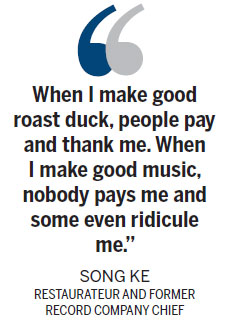
The new title of Taihe Rye Music's former CEO Song Ke surprised many - Song is now board director of the Long Joy Peking Duck restaurant.
He explains the drastic career change like this: "When I make good roast duck, people pay and thank me. When I make good music, nobody pays me and some even ridicule me."
With such first-tier Chinese pop singers as Li Yuchun and Sha Baoliang under its flag, Taihe Rye Music is one of the top-performing mainland music companies. And Song, who judged the Super Girl national singing competition, is seen as a guru in Chinese music circles.
While I cheer for the charm of Chinese food, I'm concerned about the domestic music industry. While the industry is undergoing a transformation worldwide, it's particularly anguished in China.
It's hard to find a record store in Beijing nowadays. And what sells best, according to a friend of mine who is in the record business, is so-called "car music" - compilations of remixed songs and dance tunes designed to fire-up drivers.
No company is helping musicians seriously make music.
In the 1990s, there were a bunch of record labels, each with its own characteristics and musical tastes.
Magic Stone started the "China Fire" wave of rock. Dadi produced student folk singers. Red Star specialized in producing pop rock. And Polo Arts introduced classical and world music through licensing international works.
You can't find any of these labels in the market today. No company can survive off record sales, and those who don't perish get most of their revenues through managing artists' performances and advertising.
In the end, only the most popular idols get contracts, like Super Girl winners.
The record industry is declining worldwide.
The "Big 5" major record companies became the "Big 4" in 2004 and then the "Big 3" last year.
The Grammy, which was created to award physical records, recently reduced the number of categories from 109 to 78.
In comparison, the Chinese Music Media Awards contains only 25 categories. In some of the categories, it's difficult to find enough nominees.
Digital music sales and subscription services are compensating for record companies' losses on physical formats around the globe - except for in China, that is.
In China, most of the profit is soaked up by a handful of monopolistic Web portals and telecommunication companies that don't make music but, rather, only make use of music.
The mainland record industry's heyday was the 1980s, when singers could easily sell millions of cassette tapes. Zhang Qiang, a pop idol of that time, is estimated to have sold more than 20 million copies of her 27 albums. That seems astronomical today.
But, even then, the record industry was not developing healthily. Large amounts of pirated copies took over the markets. It was often impossible to find legal records in many less developed areas.
It's the Internet, however, that has dealt the fatal blow to the Chinese record industry. The unlicensed downloading of music throws even pirated CD manufacturers out of business.
The lack of effective supervision has made it difficult for record companies to survive, which is why most of the previously active companies went bankrupt and Song now deals in roast duck.
Song is a businessman, and it's only natural for him to turn to what's more profitable. It will take some time before fair rules can be established in the Chinese music industry.
Does that mean we have to hibernate until then to hear new Chinese musical works?
Not necessarily.
The music industry is one thing, but music is another. People were making music for thousands of years before recording technology or industry.
People who love music feel it's an expression of life that can't be denied.
While the Internet bites into record companies' profits, it creates opportunities for talented independent musicians who aren't invited to join the record business' vanity fair.
Freed of record companies' domination, we can now access a greater diversity of music.
You can follow any DIY musicians on video-sharing websites and social media. If an independent musician makes good music, he or she will somehow be rewarded.
And we listeners, too, are liberated from the rule of record companies and have more control of what we listen to.
It's just a matter of time before we hear an explosion of outstanding new works.
As Song says: "Records are dead. Music isn't."