Flowers bring flavor to speciality dishes
 |
|
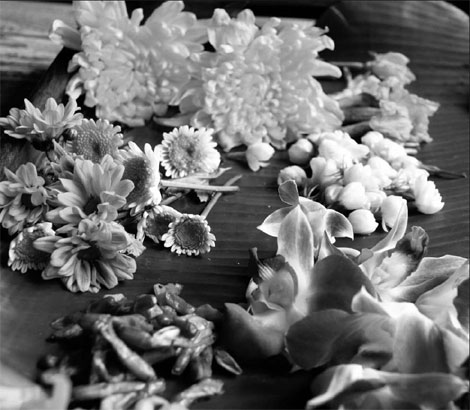
A variety of edible flowers displayed in Beijing's Yunnan cuisine restaurant, In & Out. Photos by Yan Xiaoqing / China Daily |
Blooms once used to allay hunger are appearing more often on dinner plates. Ye Jun reports.
Flowers are not only beautiful to behold but can be quite tasty as well. And more than a few varieties make good treats. At In & Out, a Yunnan cuisine restaurant in Beijing, a special page of the menu lists nothing but flower dishes, nine in total.
Among the fare are beautiful orchis, jasmine flowers, yellow chrysanthemums and tiny cucumber flowers. The menu also offers a few small flower buds found only in Yunnan: tangli flower buds and flowers, which are small and yellow; and panzhi flowers, which are narrow and bright yellow. The flowers can be served cold, lightly fried, or wrapped in flour and deep-fried, tempura style.
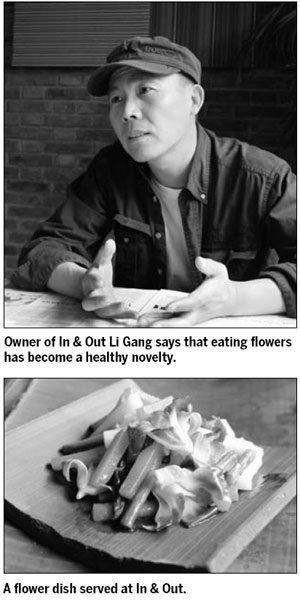
"In Yunnan, there are flower suppliers that provide more than 300 fresh edible flowers," says Li Gang, owner of the restaurant. "Because of the particular climate conditions, these flowers are available throughout the year."
Yunnan has a long tradition of making flowers into food. "Selling flowers like vegetables" is one of 18 "strange customs" in the province. One of the most famous sources of such flowers is Chenggong county in Kunming, capital of Yunnan, which contains the largest flower markets in China.
"Flowers were once eaten as a means to allay hunger at a time when food was scarce," Li Gang says. "But now they have become a novelty that is fashionable and healthy."
The tradition of eating flowers exists not only in Yunnan, but throughout China. Thirty years ago, conventional types of food were not so plentiful as they are today. So many Chinese housewives in North China turned to the white flowers of the Japanese pagoda tree, stirring them in dry flour, steaming them in bamboo cages and then serving them with a sauce.
The yellow buds of huanghuacai, or day lilies, are another common specialty. They are picked before they bloom and then dried before being used as food. Mixed with eggs, black fungus and pork slices, they can be made into a sauce to serve with noodles.
Also found on Chinese dinner tables are towel gourd flowers, pumpkin flowers, chrysanthemums and lily bulbs.
Flower dishes are not just made for everyday meals but are also used in prominent cuisines, according to Jiao Mingyao, a national level cooking master. A certain bamboo fungus (zhusun) soup, for instance, is made with jasmine flower.
"Jasmine is not put inside until the soup is ready, so that its fragrance is kept," Jiao says.
Chinese restaurants also put the famous flower into fried eggs.
Lu cuisine, for its part, offers a specialty dish consisting of fried peel prawn served with peach flower.
To make the dish, peach petals are spread over prawns that are nearly ready to be served and then lightly stirred. The pink colors of the peach flowers mix with the orange reddish color of the prawns to make a dish appealing to both the eyes and the taste buds.
Thailand orchis, an edible flower, was once often used as a decoration in Chinese restaurants - so much, in fact, that it came to be seen as trite. It now rarely garnishes plates.
"To judge whether flowers are edible, one needs to see if the roots, stems, leaves and fruits (of the same plant) are edible," Jiao says. "If these are edible, then the flowers can usually be eaten, too."
Lotus root, for example, is edible and comes with a flower that can be used in dishes.
Jiao has written a recipe book of flower dishes. According to his research, the first written record of flowers being served as food can be found in Li Sao (The Lament), a series of poems written by Qu Yuan, a poet who lived in the Warring States Period (475-221BC).
"In one line of his poem, Qu Yuan wrote that he drinks the dew of magnolia in the morning and eats autumn chrysanthemum petals for supper," Jiao says.
Another version of history holds that flowers were first used in a feast in the time of Wu Zetian, who lived in the Tang Dynasty (AD 618-907) and became the only female emperor China has had.
Because flowers are usually most appreciated for their fragrance, they are usually not cooked with something that gives off a strong smell.
"Flower dishes are usually lightly fried to taste fresh and to not be greasy," Li Gang says. "I try to avoid using a complex process when I make them so they keep their original shapes and tastes and still look beautiful."
At In & Out, Yunnan cheese balls stuffed with rose sauce have proved a popular dish. The beautiful scent of a rose is a good complement to the light taste of Yunnan cheese.
"Expats just love it," Li says.
Jiao Mingyao says he usually prepares flowers for use in a dish by poaching them in salt water. If he fries them, he does so very quickly. He also puts flowers in soup and porridge.
The aroma of flowers has a nourishing power, according to Wang Yi, director of the Nutrition Department with Guang'anmen Hospital, China Academy of Chinese Medical Sciences.
"The fragrance of flowers can open up energy channels in the liver," she says. "The aroma is soothing, and can help people adjust their spirits."
Flowers also contain glucoside, a substance believed to be good for the body.
"Different flowers have different functions," Wang says. "Yellow chrysanthemum can dispel extra heat and get rid of harmful elements. White chrysanthemum brightens one's eyes. Roses are beautifying and help slow the effects of aging."
Wang warns that a flower suitable for eating must be raised specifically for that purpose.
Despite the difficulties in cooking with flowers, the thought of putting them into food is so appealing that somebody in Beijing once started a restaurant specializing in flower dishes. It closed down after a year and a half.
"Flowers just play a part in Chinese recipes," Li Gang says. "I don't intend to over-emphasize them and use them in ways that are too complicated. Let flowers be flowers."