Chinese prefer foreign brands


 |
|
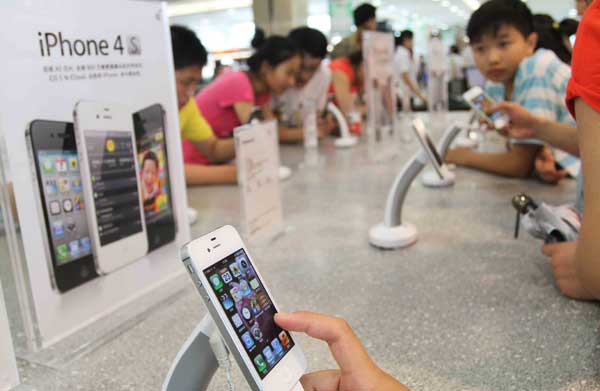
Customers try on iPhone 4S in an Apple store in Xuchang, Henan province, July 12, 2012. [Geng Guoqing/Asianewsphoto] |
While young women may be less interested in digital products such as Apple's, they are as concerned about brand names while shopping for clothes or handbags. Huang Yingwen, 24, a public relations specialist working at a Beijing PR company, finds most of her personal belongings in the closet are Western brands such as Marc by Marc Jacobs or H&M.
"Actually, the product quality of some Chinese domestic brands is as good. But their design and marketing are always flawed. The patterns and the after-sales services always let me down," sighed Huang.
Gao Aidai, 22, a researcher at a Shanghai-based information technology firm, also stressed "quality" when asked for the reason for her preference for Western or Japanese brands.
"Chinese brands can easily fall into the trap of being a copycat due to a lack of their own ideas or creativity, as I understand. But that does not exert as much influence as the quality issue. I seldom buy any domestically produced food or dairy products nowadays due to health concerns," she said.
"The Chinese people remember the quality issues which they experienced until the 80s with Chinese products. This often resulted in a credibility issue for Chinese brands vis-a-vis the consumers in their own domestic market," said Pascal Armoudom, a partner with A.T. Kearney China management consultants in charge of consumer, luxury and retail for Greater China.
Explaining the success of these international brands, Armoudom said that it is largely because "they have accumulated decades of experience in building image and value".
"For example, the difference between value perception (the sum of functional and emotional benefits that a brand can deliver in a consumer's mind) and price perception (how much is paid to buy a brand relative to comparable brands) is being taught in every Western university," said Armoudom.
"As a consequence, companies like Apple, Nestle, P&G and obviously the luxury players have today a 360-degree approach to brand value building: They continuously invest in product design and innovation. They spend a vast amount of time in defining the brand by 'story-telling' (i.e. the overall story which will make consumers buy the brand beyond product and price, also regarding emotional aspects), and on in-store experience, etc," he said.
But the homegrown Chinese brands should not be disheartened about their future.
"Although facing the challenges above, Chinese brands have been working hard to turn this around since the year 2000. They know that the time for delivering mass production at optimal cost as a guarantee for success is over," said Armoudom.
Zhou Qinnan contributed to this story.