Characteristics of Chinese Gardens
Updated: 2007-08-23 17:20
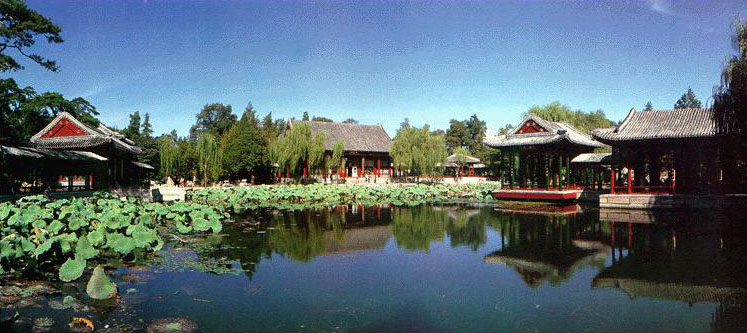
The garden is one of the important types of architectural art. It is essentially aimed at organizing an environment rich in temperament and interest and full of the beauty of artistic conception through the so-called four gardening elements including mountains, rivers, structures and plants, as well as the organic components such as roads, interior settings. In comparison to ordinary structures, the spiritual character of gardens is more outstanding, and it requires that artists have greater and higher ingenuity and imagination.
Compared with other gardening systems of the world, such as European or Islamic, Chinese gardens have their distinct national characteristics:
a. Paying attention to natural beauty. Chinese gardens carry out processing and transformation of the original terrain and land form by following the principle of "making it seem like nature", or seem naturally formed, so as to satisfy people's feeling of getting close to nature.
b. Pursuing many twists and turns. Nature itself is ever-changing and interesting. Chinese horticulturists who emulate nature necessarily pursue changing, free-style composition. It is of a completely different system compared with the Western landscape gardening theory of compels nature to accept the symmetrical rules.
c. Advocating artistic conception. Beautiful environment created by Chinese horticulturists does not stop at the stage of formal beauty, but tries to express inward feeling through outward scenery. Therefore, the ultimate key to the high or low level and success or failure in the creation of Chinese gardens depends on the cultural level, and the high or low level and crudeness or refinement of esthetic temperament and the interest of the creator.
Chinese horticulture began in the Qin Dynasty (1644-1911), and two royal garden construction upsurges occurred during the Qin/Han (221BC-220AD) and Sui/Tang (581-907) dynasties. Private gardens saw great development by men of letters during the Tang and Song dynasties, and entered the peaking stage in the Ming and Qing dynasties (1644-1911). The achievements in gardening during the Qing Dynasty attract greater attention, representing an important component of the third development upsurge in Chinese architecture. Almost all of the existing gardens were preserved during this age. The extant royal gardens are in the vicinity of Beijing, while private gardens of a higher artistic level are mostly 1concentrated in areas south of the Yangtze River. They constitute the two major schools of Chinese gardening.