Tongwan City in Nomadic Times
Updated: 2007-08-15 08:35
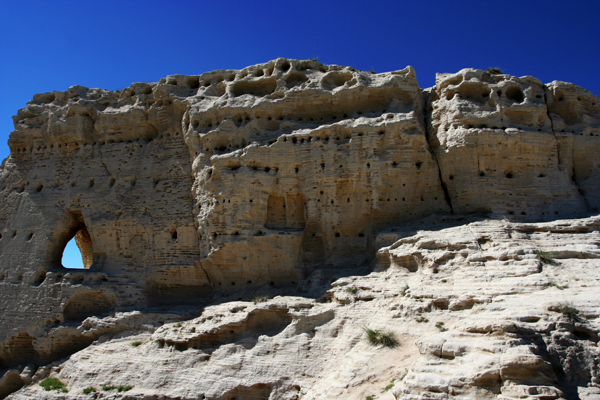
When talking about Xi'an, people generally mention that it was the capital of the Zhou (11th century-256BC), Qin (221-206BC), Han (206BC-220AD), and Tang (618-907) dynasties. However, nearly no one knows that it was also a capital of the Qian Zhao (304-329), Qian Qin (351-394), Hou Qin (384-417), Western Wei (535-556), and Northern Zhou (557-581) dynasties, which were established by nomadic minorities.
Actually, the farming Han majority as well as the nomadic minorities, throughout history, overlapped in not only Xi'an, but also the rest of China.
Nomadic minorities were not apt to writing, so that which has been written in books, by the farming Han ethnicity, represents just half of China's history, with the other half written in the green grasslands.
Most of the past descriptions of nomadic groups were unfair. For example, historic books describe Helianbobo, chief of the Huns, as a cruel, moody, and cutthroat tyrant.
Now, although we are unable to know what kind of a person he truly was, he left a big present to the world -- Tongwan City, the capital of the Daxia Kingdom. It bears testimony to the prosperity once enjoyed by these nomadic people on China's northern frontiers.
Some say that Helianbobo loved his hometown. It is because when he conquered the central plains, he left his son to rule Xi'an, while he himself went back to his Tongwan City in the northern grasslands.
Hun Capital Rises from the Sands of Time
Tongwan City, extending to nearly 20,000 square kilometers, has lain buried beneath the desert sands for more than 1,000 years. The city was laid out on an east-west axis and consisted of an outer city, an inner city, and a palace city.
The outer city was where ordinary folks lived. Government offices and the residences of the nobility were located in the inner city. Inside the palace city was the inner sanctuary of the imperial city where Helianbobo himself lived.
Historical records suggest that by the year 431, Tongwan City and its hinterland supported a population of over 40,000 Hun nomads and Han farmers. By 984 however, the city had been abandoned, and would later become buried under the shifting sands.
"Tongwan City was built on the natural contours of the ground and so is higher in the northwest and lower in the southeast. This served to provide a measure of protection against the cold winter winds. Meanwhile, the river in the north of the city could easily be channeled to supply water to the residents or used for the city moat," said Dai Yingxin, a famous archaeologist who has been engaged in field investigation and trial digs at the site for years.
"The city wall was constructed in layers by ramming a mix of cohesive white clay and sand bound together with glutinous rice gruel and slaked lime. The western section is 16 to 30 meters thick. This type of rammed earth construction has proven to be almost as strong and resistant to erosion as stone masonry," Dai said.
The Huns waged war and migrated continuously across Northeast and Northwest China from the 3rd century BC to the 5th century AD. Their activities came to seriously threaten not only the traffic along the Silk Road but even the very security of the feudal dynasties with their power bases located deep within the Central Plains.
After unifying the country, Qin Shihuang, the first emperor of the Qin Dynasty, deployed imperial troops in pursuit of the Huns and finally built the formidable protective screen of the Great Wall. The years that followed were to bring increasing exchanges with dynasties in the Central Plains and some Huns began to assimilate among the Han people. Others migrated to Central Asia and on to Europe. By the 6th century the Huns had gradually disappeared as a separate people as they merged with other peoples.
Although the Huns may have disappeared as a people, Tongwan City, which the Huns built in 6 years, was seen as an important political, economic, and military center in the next five centuries. At present its sites still standing in the desert showing Hun people's proud history.
Historical documents show the city was established at a place where there was adequate freshwater at the edge of a desert. The rise and fall of Tongwan City, lying where agriculture and animal husbandry overlapped, vividly record how human activities adversely affected the fragile ecological environment.