Imperial Tombs of the Ming Dynasty
Updated: 2007-06-11 08:58 Origins and Layout
Zhu Di, who had been stationed in Beijing for several years, became emperor in 1403 after toppling his nephew emperor. Four years later, he began constructing Beijing, and in 1421 he moved his capital there from Nanjing. When his empress died in 1407, he dispatched surveyors to Beijing to select a suitable burial site, having long planned a move to the north. After two years of reconnaissance, and Zhu Di's personal inspection and approval, the present site was determined. The area has mountains on three sides, and is rich in fertile soil and water resources, as well as being advantageous in terms of military strategy. Zhu Di decreed immediately that 40 square kilometers be enclosed as a reserve for the imperial burial grounds. In 1409, construction of the Changling Mausoleum began at the foot of Mount Tianshou, and was completed in 1427, and for the next 200 years, construction of imperial tombs ensued on this site.
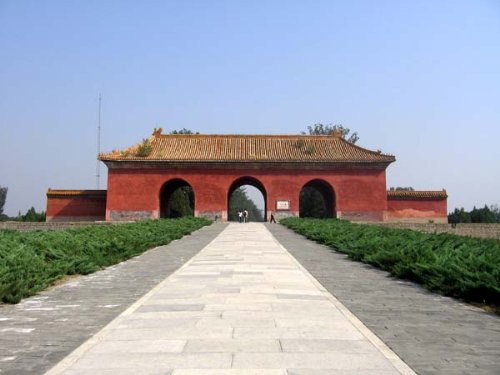
A vermilion wall encircles the tomb area, and the point of entry is a vermilion front gate that opens to the south. A kilometer south of the gate is a stone archway, 12 meters tall, supported by six columns from which five walkways emanate. The first structure to the north of the front gate is a pavilion, housing a nine-meter-tall stone stele. Further north is the 800-meter-long Divine Path, flanked by 24 large stone animals and 12 stone human figures. This path leads to various tombs.
The area called the Thirteen Ming Tombs comprises 13 separate tombs, each one
built at the foot of a hill, with very little variation in design. The tombs are
each surrounded by their own dark-red walls. The memorial hall immediately
through the gate to each tomb is for worship, and at the rear is an earth mound
containing the tomb, girdled by brick walls, named Treasure City. In between
stands a memorial tower for the deceased, in front of which are arranged a stone
incense burner, two stone vases and two stone candle holders, popularly known as
the "five sacrificial utensils."
The Changling Mausoleum, the first to be built, is the largest and best preserved of all the Ming tombs. It is located at the forefront of the burial ground, and its Divine Path starts at the Stone Archway. The 1,956-sq.-m Ling'en (Prominent Favor) Hall is built entirely of precious nanmu. Inside are 32 nanmu columns, each over a meter in diameter, and the central column is so broad, the enjoined arms of three people are required to encircle it. Even today, this mausoleum is still pervaded by the aroma of nanmu.
Zhu Di was a successful ruler and created a period of great prosperity. His success is reflected not only in the construction of his tomb, but also of the Forbidden City, which was built during his reign, as well as in the seven Chinese voyages around Asia and to Africa that took place between 1405 and 1433 at his behest.
The Siling Mausoleum, the thirteenth, last built, and smallest of the tombs
in the area, is that of Emperor Chongzhen, which he shares with his empress and
Concubine Tian, for whom the Siling Mausoleum was built. The tomb mound is only
1.3 meters high, the designated height for a commoner. In 1644, when peasant
rebels led by Li Zicheng captured Beijing, Chongzhen ordered his empress to
commit suicide before hanging himself from a tree on Coal Hill (present-day
Jingshan Park), immediately north of the imperial palace. His last words,
written on his clothes, were: "I am too ashamed to face my
ancestors. I will take off my crown, hide my face in my fallen hair
and beg that bandits tear my body apart as they please, rather than harm any of
my people." Li Zicheng did not tear him apart, but ordered the late
emperor be given a decent burial at the Thirteen Ming Tombs. However, the
official responsible for this task had no funds for a new tomb. His only
recourse was to open Concubine Tian's tomb, place the dead emperor inside to
rest beside his wife, before sealing the tomb with earth and lime. The
concubine's tomb was subsequently renamed Siling Mausoleum. After the
Manchurians entered Beijing, the Qing imperial court built a memorial hall and a
tower for the last Ming emperor.
 | 1 | 2 | 3 | 4 |  |