Unshakable prejudice
Lu Yineng, 37, was born into a family with close connections with leprosy. He followed his father's career path and became a "barefoot" doctor. Lu described his parents as "supported by a strong spiritual belief".
Lu's father, who was born in a village in Taishan city in 1935, spent years learning basic medicine from a local "barefoot" practitioner. In 1956, he was sent to work with the lepers on Daqin and spent the following 41 years on the island. In 1998, Lu took over his father's job, working as the island's only "doctor" until 2011. "Nobody wanted to work there because of fear and social prejudice. Even a cleaner in the hospital was looked down on by healthy people," said Lu.
He said at least half of the staff at the hospital in Si'an have married colleagues. Most parents are unwilling to allow their child to marry someone whose family has a history of contact with leprosy.
 |
|
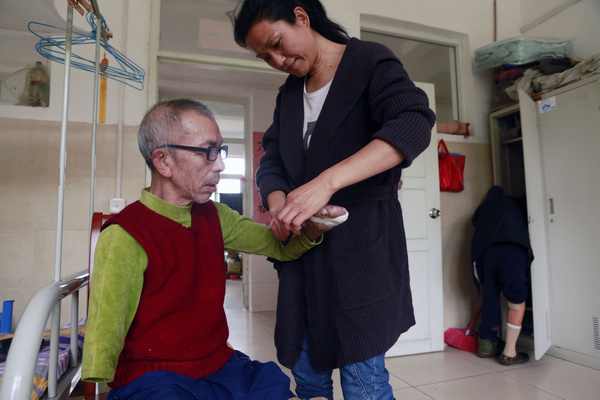
Li Yida (right) helps a patient at the hospital. [Photos by Feng Yongbin / China Daily] |
Lu's words were borne out in our interview at Si'an hospital. Some of the doctors and nurses refused to have their photos taken or to be named, to spare their family members from any possible negative reaction.
"Only my wife and daughter know that I treat lepers. None of my other relatives or friends know about my job," said a doctor surnamed Lin, who admitted that most of his colleagues kept their jobs secret. "We prefer to be called 'dermatologists'," he said.
Lin spoke of a colleague whose daughter's engagement was broken off when the family of the prospective groom discovered that her father treated lepers. Even some physicians avoid contact with the sufferers. When the Daqin residents were relocated in 2011, doctors at the general hospital that arranged the move threw away the stretchers used to transport them.
Statistics from Guangdong's Department of Health show that 2,200 patients in the province have been treated successfully, although 2,000 of them have been permanently disabled or disfigured by the disease.
However, around 100 new cases are discovered every year, but improvements in medical techniques mean that most can be treated successfully at general hospitals, and few patients suffer long-term effects.
Public prejudice means that few lepers choose to leave the colony and return home, according to Liu Zhuquan, who was once the leader of the Daqin colony. "They did not want to put pressure on their families. At least in the colony, lepers can live without shame and don't feel the need to hide their deformed bodies," he said.
Despite the despair, many patients harbor artistic designs. Some practise local opera every morning, while others learn Chinese calligraphy or organize troupes to perform traditional Guangdong dragon and lion dances.
Related:




Copyright 1995 - . All rights reserved. The content (including but not limited to text, photo, multimedia information, etc) published in this site belongs to China Daily Information Co (CDIC). Without written authorization from CDIC, such content shall not be republished or used in any form. Note: Browsers with 1024*768 or higher resolution are suggested for this site.
License for publishing multimedia online 0108263 Registration Number: 130349