 |
|
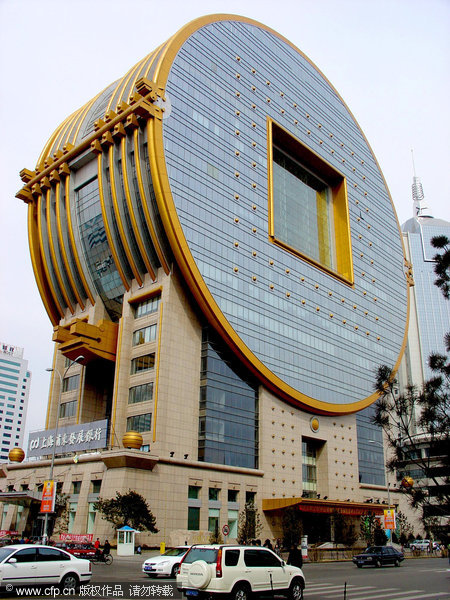
The Fangyuan Building is located in Shenyang, Northeast China's Liaoning province. The building was ranked ninth on the world's 10 ugliest buildings list, according to CNN. The building was designed by famous Taiwan architect CY Lee, designer of the Taipei 101 skyscraper. Lee wanted to fuse Eastern and Western culture into the building, but the result was incongruous. [Photo/CFP] |
BEIJING - As Chinese cities enjoy rising economic strength, their officials look to architecture as a symbol of career achievements.
Futuristic-looking buildings with shiny glass exteriors have sprung up like bamboo shoots in many cities.
These giants, shaped like pants, eggs or loops, often stand in sharp contrast to their surroundings that are in traditional Chinese or modern Bauhaus styles. These city landscapes draw the eyes of many and stir enthusiastic talk on the cyber sphere.
Criticisms on the Internet normally focus on the buildings' unaesthetic appearances and lack of functional touch.
The Gate of the Orient building in Suzhou, Jiangsu province, for example, was dubbed "giant long-johns" by Internet users, mocking the structure's strange shape.
The ring-shaped "big iron loop" in Fushun, Liaoning province, with a diameter of 157 meters and needing some 3,000 tonnes of steel to build, is said to have cost as much as 100 million yuan ($16.06 million). And its main function? Mainly ornamental.
Local officials responded that they planned the building mainly for ornamental purposes because other ideas would not work due in its location, such as using it as an amusement-park or entertainment center.
It is true that the history of architecture has never been short of controversies - even the iconic Eiffel Tower in Paris was once the target of public criticism.
However, the seemingly spreading trend of bold designs in China offers reason for reflection.
In a country of strong cultural traditions and only modest wealth, the unusually big appetite for standing-out buildings comes from what looks like too eager a pursuit of so-called modernity by architects and local governments.
It is understandable that architects worldwide are known for their love for creativeness and they should be so long as they are allowed. Therefore, the responsibility falls on local governments to double check if designs fit within communities.
Local governments in China, who often easily give green lights to such construction proposals, should realize eye-catching buildings will not change the image of their cities. Instead, it is their record on promoting public well-being that counts.
Public opinions should be solicited before governments decide whether to approve these projects, particularly if they are funded with taxpayers' money, like the "big iron loop."
No matter how big a budget governments have, the money should be spent more wisely. After all, a country that still sees a heavy presence of poverty as China cannot afford to be a playground for architects.
Architectural designs should not overlook functionality either because that is the lifeline of architecture if it is to last. Urban planners need to be more far-sighted to avoid leaving behind standing jokes to later generations.
Related:




Copyright 1995 - . All rights reserved. The content (including but not limited to text, photo, multimedia information, etc) published in this site belongs to China Daily Information Co (CDIC). Without written authorization from CDIC, such content shall not be republished or used in any form. Note: Browsers with 1024*768 or higher resolution are suggested for this site.
License for publishing multimedia online 0108263 Registration Number: 130349