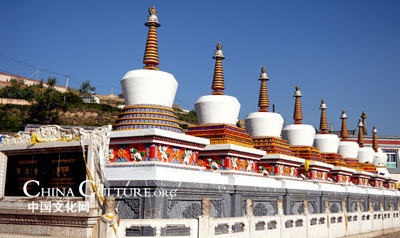
The Tar Monastery, one of the six most important monasteries of the Gelukpa (Yellow Hat) school of Tibetan Buddhism, is a large complex featuring dozens of halls and towers on a mountainside in both Tibetan and Han architectural styles.
Located in Huangzhong County, 25 kilometers from Xining, capital of Qinghai province, the monastery was built in 1560 in honor of the founder of Gelukpa School, Tsongkhapa. It’s known for its many butter sculptures, mural paintings and barbolas which fully demonstrate the artistic style and skill of Tibetan culture.
Butter sculptures
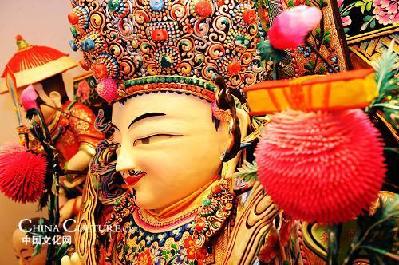
Traditionally, Tibetan butter sculptures are displayed on monastery altars and family shrines as offerings. The butter sculptures originated in Tibet and were introduced to the Tar Monastery in the early 17th century. Many monks in monasteries in China make butter sculptures, but those of the Tar Monastery excel in technique and scale.
Butter sculptures cover a broad range of themes, but mostly, they center on Buddhism, historic stories, Buddha, personal biographies, flowers, birds, fish, insects, and pavilions. Often the sculptures are part of a series that depicts a story, such as the life of Sakyamuni.
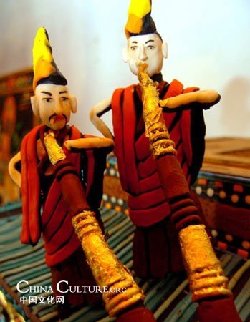
The making of a butter sculpture is itself a daunting task. As butter made from yak milk melts in warm weather, butter sculptures have to be made by hand during the coldest months of the year, usually from October to January.
As time goes on, they are imbued with the trends of the times. For example, the butter sculpture "The Story of Sakyamuni" not only enriched the traditional style of butter sculpting, but also reflects real life. In this way, the former singular method has evolved into a multi-method system, including a combination of stereoscopic sculptures and reliefs -- a combination of single sculptures and multi sculptures.
|