Fifty years.
"You can't get away from that number," Keith Richards said with a chuckle by telephone from Paris, where the Rolling Stones have been rehearsing. The Stones, led by Mick Jagger and Mr. Richards, played their first gig in 1962.
And with less than two months remaining in this anniversary year, the machinery of commemoration has swung into motion.
There are arena concerts scheduled in London (November 25 and 29) and Newark, New Jersey (December 13 and 15). There are documentaries new (on HBO) and old (on DVD). There are even two new Stones songs recorded this year: "Doom and Gloom," a Jagger song that mentions fracking, and "One More Shot," written by Mr. Richards.
In one way the Stones have been doing the same thing for half a century: playing obstinately unpolished rock 'n' roll. Yet around that music, every conceivable meaning has changed.
What once was taken as radical, wanton, even dangerous has become old-school. The songs that once outraged parents are now oldies to pass on to the grandchildren. "You'd gone all the way from 'It's too dangerous to go' to people bringing their children" to shows, Mr. Jagger said from Paris. And a band that was once synonymous with a riotous volatility has become - despite all commercial, cultural and chemical odds - a symbol of stability. Members now describe the band with an unexpected word for the Rolling Stones: discipline. "Although it seems to be shambolic, it's a very disciplined bunch," Mr. Richards said.
The guitarist Ronnie Wood, who joined the band in 1975, agreed. "No matter what was going on on the outside, no matter how much we whooped it up," he said, "we felt a responsibility, and we still do, to make great music."
Simple familiarity, through the passage of time and generations, is one reason the Stones' popularity has endured. Yet since the late 1980s, when the Stones pulled themselves together after some rough patches to make "Steel Wheels" and return to the stadium circuit, arguably every tour and album has been largely a victory lap for what they accomplished in their first 20 years.
By then Mr. Jagger and Mr. Richards had forged a catalog of great songs - "(I Can't Get No) Satisfaction," "Ruby Tuesday" and "Honky Tonk Women," to name a few classics.
The band's box office potential is unmistakable. Latter-day Stones studio albums, when they get around to making them, have each sold at least a million copies in the United States without major hit singles.
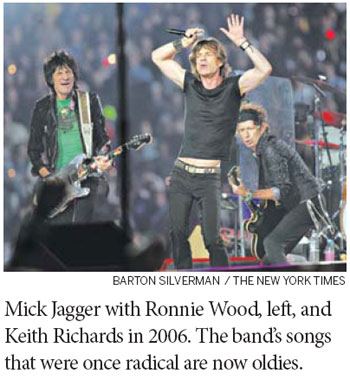
Nostalgia and durable songs are part of the Stones' perpetual appeal. So are the big-stage rock spectacles that the band helped pioneer, with pyrotechnics or perhaps a cherry-picker lifting Mr. Jagger over the crowd.
It doesn't hurt ticket sales that Mr. Jagger, at 69, is still limber enough to prance, twitch and shimmy all over a stage.
The Rolling Stones keep their sound loose: it's practiced and not to be mistaken for sloppy; precisely imprecise. Above Charlie Watts's drumming the band's two guitars share a musical cat's cradle. "We're always sliding between rhythm and lead," Mr. Richards said.
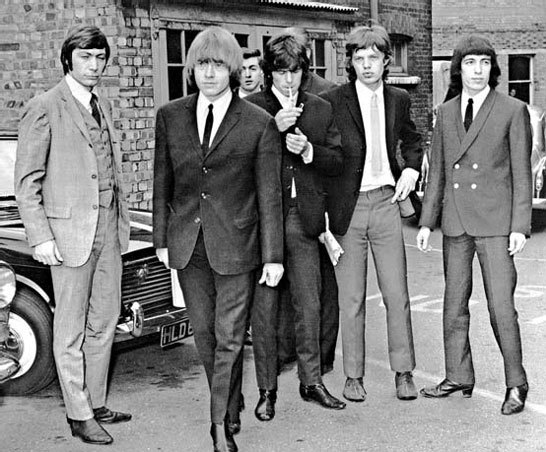
But songs and showmanship still don't fully explain the Stones' hold on their audience. Soon after forming, they made a choice as fateful as their musical tastes. Their early-1960s manager, Andrew Loog Oldham, urged them to become the "anti-Beatles": the opposite of an ingratiating, uniformed, clean-cut pop-rock band.
"The Beatles being so squeaky clean, they were obviously wearing the white hat," Mr. Richards recalled. "The other role to play was putting the black hat on."
That attitude not only freed the Stones to look and behave as they pleased, but made them rock archetypes, living out a freedom that fans could only wish for.
The Stones' distant whiff of anarchy is still a draw, especially because it's underscored by the tight-but-loose sound of the band, the way even venerable songs sound up for grabs.
The Stones say that morale is high at the Paris rehearsals. "Once the guitar straps are put over their heads, it's back into it," Mr. Watts said. "It's what we do."
Mr. Richards pronounced himself "amazed" at the band's longevity. "There's just a feeling that we were meant to do this, we have to do this, and we're just following the trail."
The New York Times



 Comments
  Print
Print  Mail
Mail  Large Medium Small