Comments()
  Print
Print  Mail
Mail  Large Medium Small
分享按鈕
0
Large Medium Small
分享按鈕
0
 |
|
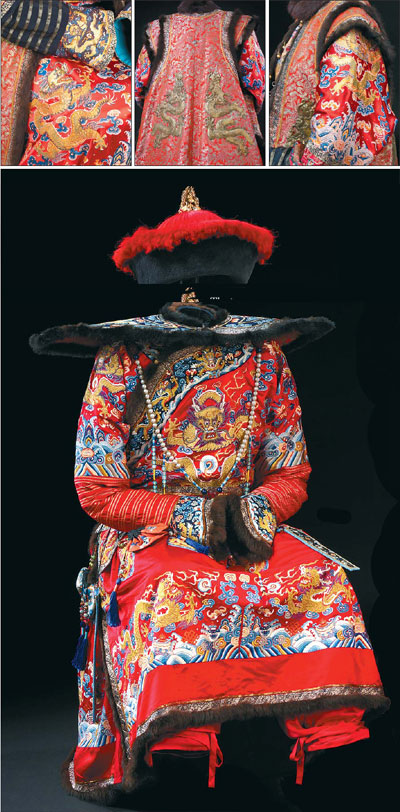
Robes and hat worn by the actor who played Qing Emperor Puyi in The Last Emperor, designed by James Acheson. Photos provided to China Daily |
Costumes from The Last Emperor are among those on show in the Hollywood Costume exhibition at London's Victoria and Albert Museum. Tiffany Tan talks to three-time Oscar-winning costume designer James Acheson.
What does a biopic on the last Chinese emperor have in common with a film about a Marvel superhero who spins webs? A three-time Oscar-winning costume designer. Until Jan 27, their main characters' costumes are also sharing the spotlight in an exhibition at Britain's Victoria and Albert Museum, alongside 129 other iconic movie costumes from the last century.
Included are Dorothy Gale's blue and white pinafore in The Wizard of Oz; Darth Vader's dark suit, cape and mask in the first Star Wars; and Holly Golightly's sleeveless black dress in Breakfast at Tiffany's.
In the Hollywood Costume exhibition's first gallery are two robes and hats worn by the actor who played Qing Emperor Puyi (1906-67) in The Last Emperor.
These intricate pieces were among the 10,500 costumes James Acheson designed for the film, which gave the Englishman his first Oscar in 1987. (He received his second for Dangerous Liaisons the year after and another for Restoration in 1995.)
Acheson, who has just finished shooting the latest Superman film, The Man of Steel, recalls being struck by the irony of the situation when he was offered the Beijing project.
"I remember saying to Bernardo Bertolucci, the director, when he asked me to work on The Last Emperor, that it was a bit like asking a Chinese designer to create the costumes for 'The Life of the British Queen Victoria'," the 66-year-old designer tells China Daily in an e-mail.
"Working in another country is like being on a tightrope with no safety net. I was scared most of the time, but sometimes fear can be controlled and channeled into the creative process."
Working in the pre-digital technology age also had its unique challenges.
"We had no mobile telephones - how on earth did we make that epic without a cell phone? Beijing studios had a few land lines but most of the time it was production assistants delivering messages, verbally," he says.
"These days modern film technology can easily turn 200 costumed extras into 2,000 people using computer-generated imagery (CGI). But in 1986, we needed to clothe every one of those thousands of people," Acheson writes in the exhibition's accompanying book.
For instance, the scene showing the child emperor Puyi running from the Forbidden City's throne room, through a huge yellow curtain, to be greeted by 3,000 kowtowing courtiers, took half a year to prepare, says the designer.
And without the aid of digital silk-screen printing and dyeing, as well as laser cutters, all the costumes and accessories had to be made by hand. Within budget, of course.
"To create the illusion of detailed, exquisitely hand-crafted clothes for a fraction of the true cost, I was forced to find ways of cheating the eye of the camera," Acheson says.
"Much of the embroidery was modeled and sculpted in wax, cast in aluminum and then gold plated Larger motifs of swirling dragons were sculpted and then cast in a flexible glue, gold plated and stuck to the garment."
Although some of the clothes were manufactured on the Chinese mainland and in Hong Kong, the principal costumes were created in England and Italy.
When Acheson and his team (involving 250 people in five countries) began making the clothes in the fall of 1985, China's gigantic garment manufacturing industry was still a decade away from being born.
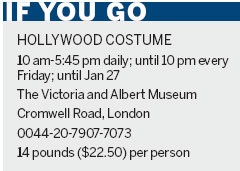
The Last Emperor's yellow and red robes and matching hats are the only Chinese costumes in the Harry Winston-sponsored exhibition, which took five years to organize. They were loaned by the film's producer Jeremy Thomas, who hung on to them all these years.
"One of the reasons he had kept the costumes was in the hope that they could be featured in exhibitions," says the Victoria and Albert's assistant curator Keith Lodwick. "It is unusual for this to happen - often costumes are sold off once filming is completed."
For Acheson, the entire film was an unusual experience, especially when compared with mega productions like Spiderman.
"The attitude of the producers and director of a major Hollywood blockbuster are understandably very different. Their desire and focus is on creating a product that will generate a huge amount of profit for the studio and its shareholders," he says.
"The main difference is between art and commerce."
Contact the writer at tiffany@chinadaily.com.cn.



Copyright 1995 - 2010 . All rights reserved. The content (including but not limited to text, photo, multimedia information, etc) published in this site belongs to China Daily Information Co (CDIC). Without written authorization from CDIC, such content shall not be republished or used in any form. Note: Browsers with 1024*768 or higher resolution are suggested for this site.
License for publishing multimedia online 0108263 Registration Number: 20100000002731