Exotic Xinjiang
Updated: 2011-11-28 16:13
By Han Bingbin (China Daily)
|
|||||||||||


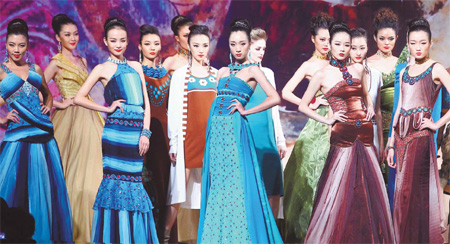
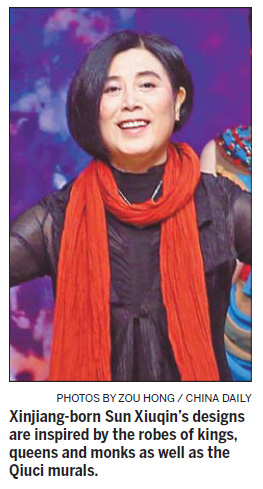
China's rich and colorful ethnic heritage takes to the runway with the unique designs of Xinjiang-born Sun Xiuqin. Han Bingbin gets a close-up look.
To Sun Xiuqin, it is the designer's responsibility to introduce a unique cultural identity that resonates with a particular period of history. Her latest collection, shown at the recent Beijing International Fashion Week, does just that. It draws inspiration from an ancient kingdom called Qiuci, located on the route of Silk Road, where traders from East and West met and exchanged goods and culture. Qiuci's dominance included the area now known as Kuche county in the Xinjiang Uygur autonomous region, an area that still boasts vestiges of cultural influences from ancient Greece, Rome, Persia and, of course, the central plains of China. The most well known among these surviving traces include the murals of the grottoes of Qiuci, which illustrated the early history of Buddhism's entry into China from India.
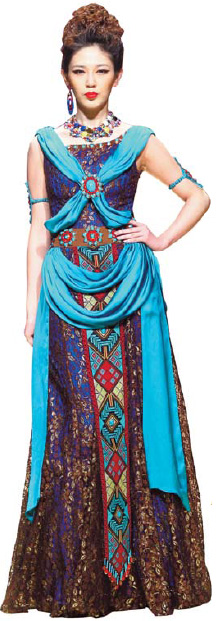
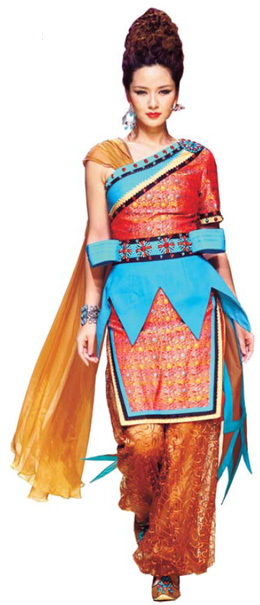
Sun's designs are inspired by the robes of kings, queens and monks as well as the Qiuci murals, and the hardest part was trying to reproduce the historical culture behind the wardrobes.
Color was a key challenge. Sun wanted her models to look as if they had just stepped out of the grotto murals, so she looked for textiles that reflect the same palette.
From the few unfaded patches of murals, she determined that the main colors were cobalt blue, brown, pink, green and wine-red. Her next problem was that the cloth she found was too shiny, shattering the illusion of age that she wanted.
That was when tulle came into her mind, an inspiration that gives Sun great pride.
After she layered her designs with tulle, mostly brown and wine-red with ornamental embossing, the brassy luster was dimmed and the tulle created the dulled patina that Sun wanted, reminiscent of the time-sculpted look she was after.
Sun also used gold embroidery, lines which reflected Qiuci's long and illustrious history. Under Sun's hand, the gold thread blossomed into floral sprays, over-lapping rhombuses and Buddhist totems on waistlines and necklines.
Ribbon-like scarves, a peculiar characteristic of ancient Qiuci costumes, wind around neck and shoulders, trail from the waist, or criss-cross the chest - just as they do on the fairies of the Qiuci grottoes.
Some pieces have turndown collars, a typical symbol of many nomadic ethnic groups on horseback.
Turquoises and other colored gems, typical of Xinjiang, are embroidered along the necklines and waists.
Sun uses material from Xinjiang, where one-third of China's cotton is produced and the region's flax and wool production ranks among the country's top three.
To optimize these rich resources, Sun also pushed out a collection of cashmere shifts, all boldly emblazoned with graceful, yet solemn Buddhist images.
"Fashion design should have a cultural uniqueness," Sun says. "Xinjiang has so many cultural themes to be explored. I will continue to be the forerunner."
You can contact the writer at hanbingbin@chinadaily.com.cn.