Comments
  Print
Print  Mail
Mail  Large Medium Small
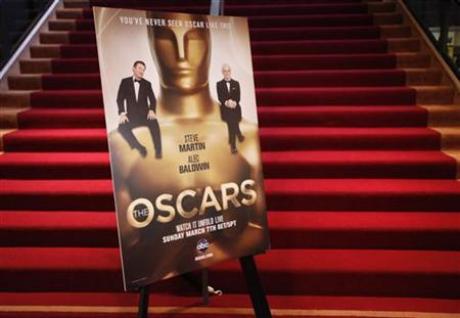
LOS ANGELES - Oscar's campaign season officially ends on Tuesday evening, when ballots are due at Academy headquarters.
But for Bill Mechanic and Adam Shankman, producers of Sunday night's 82nd annual Academy Awards, the anxiety is just beginning. Although they've adopted the motto "expect the unexpected" to generate viewer interest in the broadcast, that doesn't mean they themselves want to be surprised.
But Oscar shows rarely stick to the script.
Weatherunderground.com predicts a 40% chance of showers and a chilly red-carpet. World events also can intervene. That last happened in 2003, when the U.S. invaded Iraq five days before the show, and the Academy shut down the red carpet altogether.
The real nightmare that haunts every Oscar producer is that the show itself turns into a globally broadcast pratfall.
The 61st Academy Awards ceremony, held March 29, 1989, at the Shrine Auditorium, stands as the great object lesson.
"Rain Man" was named best picture, and that movie's Dustin Hoffman and "The Accused's" Jodie Foster won the top awards.
But that's not why the evening is remembered. Instead, Oscarologists still shake their heads over the infamous opening production number in which Merv Griffin sang "I've Got a Lovely Bunch of Coconuts!" amid an onstage re-creation of the Cocoanut Grove nightclub before turning the stage over to a high-pitched Snow White, who boogalooed with Rob Lowe to the tune of "Proud Mary."
As producer of that year's show, Allan Carr was the man responsible. As author Robert Hofler writes in a dishy new biography of Carr, "Party Animals: A History of Sex, Drugs, and Rock 'n' Roll Starring the Fabulous Allan Carr," which Da Capo Press is publishing this month, "Allan tried to reinvent the Oscars through camp comedy." But the Academy's old guard saw it differently.
In an open letter, 17 prominent Hollywood figures, including past Academy president Gregory Peck, proclaimed the ceremony "an embarrassment to both the Academy and the entire motion picture industry. It is neither fitting nor acceptable that the best work in motion pictures be acknowledged in such a demeaning fashion."
Was it really as bad as all that? Certainly, earlier Oscar shows had seen their share of misconceived production numbers. But, yes, the 61st opener did manage to combine over-the-top excess with breathtakingly amateur execution.
To be sure, that wasn't the initial plan.
Carr accepted the challenge because he was nothing if not a showman. He'd parlayed a career as a manager, turning performers like Ann-Margret into Las Vegas mainstays, into a successful gig as producer of "Grease," which, at $188 million, still holds the domestic title of top-grossing movie musical. He'd also scored a hit on Broadway with the musical "La Cage aux Folles."
But his luck ran out with 1980's "Can't Stop the Music," in which he tried to package the Village People for mainstream consumption just at the moment disco died.
An inveterate party-giver, who'd entertained most of Old and New Hollywood at his Hillhaven Lodge in Benedict Canyon, Carr viewed the Oscars as the ultimate party at which he'd mix old-time stars with up-and-comers.
His biggest mistake was falling in love with San Francisco's long-running musical revue "Beach Blanket Babylon," inviting its producer and creator Steve Silver to devise the opening number. But what worked in a Frisco nightclub simply didn't translate to the expansive stage of the Shrine. The nominees, just settling into their seats, didn't know what to make of Ellen Bowman's simpering Snow White. And while five years later Disney would bring dancing silverware to Broadway in its musical version of "Beauty and the Beast," the dancing tables that took over the stage on Oscar Night just looked silly.
A second number -- featuring such young actors as Patrick Dempsey, Christian Slater and Ricki Lake cavorting around the stage as they sang of dreams of becoming an Oscar winner -- was almost as much of a bomb.
And the morning after the show, Carr's phone was virtually silent instead of ringing off the hook with the customary kudos. A few days later, Disney sued the Academy for copyright infringement for inviting Show White to its ball, forcing the Academy to make a formal apology.
Never one to shy away from hyperbole, Carr told The Hollywood Reporter in advance of the show: "If nothing else, this will be the most beautiful Academy Awards of all time. It will be the antithesis of tacky."
When it turned out to be exactly the opposite, the Hollywood establishment pounced -- the producer's partisans suspected a certain amount of homophobia was directed at the unapologetically gay Carr -- and his career was effectively over. His party days behind him, Carr retreated into relative seclusion until his death in 1999.
The irony, though, is that for all his missteps, Carr introduced elements that since have become awards-show staples.
Hofler credits him with changing the presenter's mantra "And the winner is ..." to "And the award goes to. ..." Carr drafted Rodeo Drive retailer Fred Hayman to urge designers to dress the stars. He emphasized the red carpet arrivals during the first minutes of the show, an element that has since been spun off into its own preshow. And his broadcast actually saw the best ratings the Oscars had seen in five years.
In the process, though, Carr learned the hard way a fact that every Oscar producer since has had to be wary of: When it comes to injecting showmanship into the Academy Awards, you can be damned if you don't but also damned if you do.


Copyright 1995 - . All rights reserved. The content (including but not limited to text, photo, multimedia information, etc) published in this site belongs to China Daily Information Co (CDIC). Without written authorization from CDIC, such content shall not be republished or used in any form. Note: Browsers with 1024*768 or higher resolution are suggested for this site.
License for publishing multimedia online 0108263 Registration Number: 20100000002731