Comments
  Print
Print  Mail
Mail  Large Medium Small
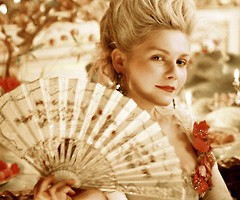 Marie Antoinette has, in popular history, been accused of frivolity, irreverence and disdain for historical precedent. Sofia Coppola's indulgent, frothy biopic will be charged with precisely these same offenses. What more could a filmmaker ask?
Coppola's third movie, reportedly in the works for many years, has finally landed in the U.S. after a rocky premiere at Cannes, where the French media reaction was, shall we say, mixed. Wags there accused the young filmmaker of taking certain liberties with the facts, not only of the doomed Queen's life but of French history.
It's true that this sugarcoated romp doesn't take itself, or its source material, particularly seriously, but if you're confident your grasp of European history can withstand the assault of two hours of bubbly entertainment, "Marie Antoinette" guarantees you a good time.
Moved by Antonia Fraser's sympathetic 2001 biography of the so-called "teen queen," Coppola began work on a screenplay immediately. The result is a story that meshes beautifully, if unexpectedly, with Coppola's languid, highly stylized brand of filmmaking. "Marie Antoinette" is a throwback to Coppola's beginnings, sharing a sun mote-flecked dreaminess with "The Virgin Suicides."
As in her first two films, Coppola digs deeply here into the suffering brought on by claustrophobia and intense loneliness. We see the same sense of dread that enveloped an entire family in "Suicides" and made its mark on a lonely traveler in "Lost in Translation." Here, its target is an adolescent queen, trapped in a gilded, poisonous cage.
From the movie's first frame to its final, devastating moments, Coppola's direction brings to life a gauzy world marred only occasionally by serious concerns, a world marked by utter innocence, supreme ignorance, or some combination of the two.
Marie Antoinette would have empathized with today's tabloid stars. Her sex life was the subject of hurtful gossip; her every move was scrutinized and choreographed. Literally handed over from Austria to enhance diplomatic ties with France, the 15-year-old is deprived of her closest friends, her beloved dog, even her clothes. Presented to her new subjects in the French court, she smiles even as the lips around her curl in disdain.
Any story about Marie Antoinette must emphasize the queen's youth, and Kirsten Dunst, with her round cheeks and lopsided dimple, plays a convincing teenager, wavering between studied perkiness and abject fear. (One particularly artful shot has the camera pulling back from Dunst's tiny figure framed by one of the palace's vast windows, her loneliness and isolation almost palpable). Just as the title character grows into her new role, Dunst also seems to relax, easing off her high-octane effervescence.
Jason Schwartzman, Coppola's cousin, must have been thrilled to be cast as Louis XVI, who is described in historical accounts as "homely" and "stout." Rip Torn, as an animated Louis XV, seems to be having a fantastic time, as does Asia Argento, who's really challenging herself as the elder King's crude concubine.
Defiantly shunning an unspoken rule of period pieces, Coppola has the actors speaking in their natural voices, which seems odd until, about a third of the way through the movie, it doesn't. After all, nothing is more distracting than actors stumbling over recently acquired accents, and here we're free to concentrate on what's being said and done, rather than whether Schwartzman will be able to muster up an adequately Gallic twist on his next line. And don't go into this expecting chamber music: "I Want Candy," by '80s throwback Bow Wow Wow, blasts as MA and her ladies in waiting scramble joyfully through bolts of exquisite fabrics, boxes of fabulous shoes and trays of delectable sweets. It's typical of the movie's deliberately anachronistic, unstuffy approach to its subject matter, and it all works beautifully. In another scene, Coppola deftly pairs New Order's aptly named "Ceremony" with images of rambunctious youth celebrating an 18th birthday.
Coppola, who has a cultish following in France (at least before this film), was granted unprecedented access to Versailles, and she clearly took full advantage of the privilege. Visually, "Marie Antoinette" is an embarrassment of riches, frame after frame of lush scenery, swirling gowns and unimaginable wealth.
That wealth, of course, came with a price: Everything the future king and his wife do is shrouded in stultifying pageantry; their wedding night is presided over by a roomful of high-ranking members of the court, their private tragedies on display. They're not unlike rare and exotic animals in a zoo. Their awkwardness makes them human, which inspires sympathy, which in turn inspires real sadness at their inevitable fate at the hands of an understandably outraged underclass.
"Marie Antoinette" is not a perfect movie, but it's a very good movie about one of history's most iconic figures. Insouciant but never cavalier, Coppola's latest effort should prove definitively she's a talent in her own right.


Copyright 1995 - . All rights reserved. The content (including but not limited to text, photo, multimedia information, etc) published in this site belongs to China Daily Information Co (CDIC). Without written authorization from CDIC, such content shall not be republished or used in any form. Note: Browsers with 1024*768 or higher resolution are suggested for this site.
License for publishing multimedia online 0108263 Registration Number: 20100000002731