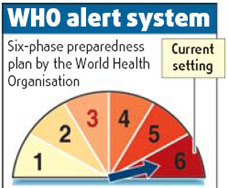
The fragile recovery in the Chinese and global economies has been dealt a blow with the H1N1 flu outbreak declared a pandemic Thursday night.
Analysts and experts in China said the announcement would have a significant impact on the country's travel, tourism and foreign trade sectors.
In a statement sent to health officials, the WHO said it decided to raise the pandemic warning level from phase 5 to 6 - its highest alert - after holding an emergency meeting with its flu experts.
WHO chief Margaret Chan was expected to make a formal announcement later last night.
In Beijing, Mao Qun'an, spokesman for the Ministry of Health (MOH), told China Daily last night that a press conference would be held in the afternoon today to explain the latest situation.
Zeng Guang, top epidemiologist with the Chinese Centers of Disease Control and Prevention (CDC), said there is no need to panic.
The MOH is ready with countermeasures based on the specific epidemic situation, such as the closure of schools when multiple infections are detected, he added.
Vivian Tan, spokesperson for the WHO Beijing Office told China Daily last night that China is categorized as a country with sporadic cases and a few small clusters of domestic transmissions. Tan also said the MOH told the WHO Beijing Office last month that the country has enough antiviral medication and is expanding medicine stockpiles.
But it is the economy which looks set to bear the brunt of the announcement.
Gao Shanwen, analyst at Essence Securities, said the travel, hotel, transport, retail sales and entertainment sectors will see a decline.
"And if consumption falls in other countries, it may affect China's exports, which are already severely hit by the financial crisis. But considering historical experience, the flu's overall impact on the economy will be limited," Gao said.
Gao Yaosong, director of the Shanghai Research Institute of International Economy and Trade, agreed the pandemic alert will deal a big blow to exports and imports, turning matters from bad to worse.
A series of restrictions will be imposed on the movement of both people and goods, making it difficult for trade delegates to travel overseas freely, he said.
"The news is the last thing we want to hear," said Zhang Qingzhu, marketing manager of China Comfortable Travel Services in Beijing.
"The government might adopt stricter policies on travel, but what is worse is that people will have greater fear about travel. It will be a devastating blow for tour operators," she said.
Li Xinjian, a professor at the school of tourism management of Beijing International Studies University, said that outbound tourism will be the most severely hit, because H1N1 infections are far worse overseas.
The inbound market, however, will not suffer much more from the raised alert level, because even at level 5, many foreign tourists had already dropped plans to visit China because of strict quarantine measures, he said.
Zhu Mei, a spokeswoman for Air China, said the raised alert level could further hit airlines' international flights.
"At level 5, most group visits to North America were already cancelled now, all airlines face a further drop."
The long-awaited pandemic decision by the WHO is scientific confirmation that a new flu virus has emerged and is quickly circling the globe.
It will trigger drugmakers to speed up production of a vaccine and prompt governments to devote more money toward efforts to contain the virus.
"At this early stage, the pandemic can be characterized globally as being moderate in severity," the WHO said in the statement, urging nations not to close borders or restrict travel and trade.
The WHO also told countries it was in "close dialogue" with flu vaccine makers and it believed the firms would work "to ensure the largest possible supply of pandemic vaccine in the months to come".
On Wednesday, the WHO said 74 countries had reported nearly 27,737 cases of swine flu, including 141 deaths.
The agency has stressed that most cases have been mild and required no treatment, but the fear is that a rash of new infections could overwhelm hospitals and health authorities - especially in poorer countries.
The last pandemic - the Hong Kong flu of 1968 - killed about 1 million people. Ordinary flu kills about 250,000 to 500,000 people each year.
Many health experts say WHO's pandemic declaration could have come weeks earlier but the international agency has become bogged down by politics.
AP contributed to the story