|
Why does US rev up China threat?
By Michael T. Klare (The Nation)
Updated: 2005-10-08 15:38
This project was well under way when the 9/11 attacks occurred. As noted by many analysts on the left, 9/11 gave the neoconservatives a green light to implement their ambitious plans to extend U.S. power around the world. Although the shift in emphasis from blocking future rivals to fighting terrorism seemed vital to a large majority of the American people, it troubled those in the permanent-supremacy crowd who felt that momentum was being lost in the grand campaign to constrain China. Moreover, antiterrorism places a premium on special forces and low-tech infantry, rather than on the costly sophisticated fighters and warships needed for combat against a major military power. For at least some U.S. strategists, not to mention giant military contractors, then, the "war on terror" was seen as a distraction that had to be endured until the time was ripe for a resumption of the anti-Chinese initiatives begun in February 2001. That moment seems to have arrived.
Why now? Several factors explain the timing of this shift. The first, no doubt, is public fatigue with the "war on terror" and a growing sense among the military that the war in Iraq has ground to a stalemate. So long as public attention is focused on the daily setbacks and loss of life in Iraq — and, since late August, on the devastation wrought by Hurricane Katrina — support for the President's military policies will decline. And this, it is feared, could translate into an allergy to costly military operations altogether, akin to the dreaded "Vietnam syndrome" of the 1970s and '80s. It is hardly surprising, then, that senior U.S. officers are talking of plans to reduce U.S. troop strength in Iraq over the coming year even though President Bush has explicitly ruled out such a reduction.
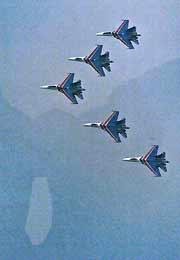
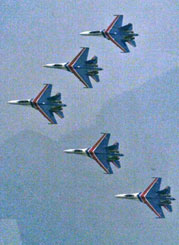
At the same time, China's vast economic expansion has finally begun to translate into improvements in its net military capacity. Although most Chinese weapons are hopelessly obsolete — derived, in many cases, from Soviet models of the 1950s and '60s — Beijing has used some of its newfound wealth to purchase relatively modern arms from Russia, including fighter planes, diesel-electric submarines and destroyers. China has also been expanding its arsenal of short-range ballistic missiles, many capable of striking Taiwan and Japan. None of these systems compare to the most advanced ones in the American arsenal, but their much-publicized acquisition has provided fresh ammunition to those in Washington who advocate stepped-up efforts to neutralize Chinese military capabilities.
Under these circumstances, the possibility of a revved-up military competition with China looks unusually promising to some in the military establishment. For one thing, no American lives are at risk in such a drive — any bloodletting, should it occur, lies safely in the future. For another, there has been a recent surge in anti-Chinese sentiment in this country, brought about in part by high gasoline prices (blamed, by many, on newly affluent car-crazy Chinese consumers), the steady loss of American jobs to low-wage Chinese industrial zones and the (seemingly) brazen effort by CNOOC to acquire Unocal. This appears, then, to be an opportune moment for renewing the drive to constrain China. But the brouhaha over Unocal also reveals something deeper at work: a growing recognition that the United States and China are now engaged in a high-stakes competition to gain control of the rest of the world's oil supplies.
Just a decade ago, in 1994, China accounted for less than 5 percent of the world's net petroleum consumption and produced virtually all of the oil it burned. At that time China was number four in the roster of the world's top oil consumers, after the United States, Japan and Russia, and its daily usage of 3 million barrels represented less than one-fifth of what the United States consumed on an average day. Since then, however, China has jumped to the number-two position among the leading consumers (supplanting Japan in 2003), and its current consumption of about 6 million barrels per day represents approximately one-third of America's usage. However, domestic oil output in China has remained relatively flat over this period, so it must now import half of its total supply. And with China's economy roaring ahead, its need for imported petroleum is expected to climb much higher in the years to come: According to the Department of Energy (DOE), Chinese oil consumption is projected to reach 12 million barrels per day in 2020, of which 9 million barrels will have to be obtained abroad. With the United States also needing more imports — as much as 16 million barrels per day in 2020 — the stage is being set for an intense struggle over access to the world's petroleum supplies.
|