|
Full Coverages>World>Iran Nuke Issue>News | |
|
|
|
|
|
|
|
|
|
|
|||||||||||||||||
|
|
EU powers start work on Iran nuclear resolution
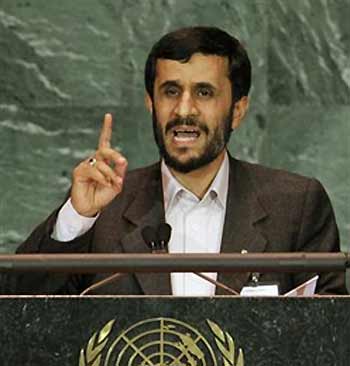
The United States and European Union agreed on Sunday to press for Iran's nuclear program to be reported to the U.N. Security Council, but struggled to win backing from Russia and developing nations. Britain, France and Germany were drafting a resolution asking the U.N. nuclear watchdog to act after President Mahmoud Ahmadinejad told the General Assembly on Saturday that Tehran was determined to press ahead with making nuclear fuel and branded Western efforts to restrict the program "nuclear apartheid."The West suspects Tehran is working covertly to develop nuclear weapons. The standoff will come to a head in Vienna on Monday when the 35-member governing board of the International Atomic Energy Agency begins a crucial week-long meeting. "We will be putting forward a resolution that calls for taking Iran to the Security Council," a senior diplomat from one of the three EU countries, known as the EU3, told Reuters. Political directors of the EU3 and United States differed on tactics when they met at the United Nations. Diplomats said Washington sought a quick IAEA vote, while the Europeans wanted time to build a broader consensus. U.S. Undersecretary of State Nicholas Burns told the BBC that Ahmadinejad's speech had left little room for compromise. Asked if there would be a vote this week, Burns said: "It's hard to say. I think ultimately there will be a referral."
"Do we think we have a majority? Yes, we probably have. Do we think that a majority of, say, 20 out of 35 with some big countries voting against or abstaining would be enough to pressure Iran? That is the question," he said. IAEA BOARD DIVIDED A senior Bush administration official said that while Washington was laboring to broaden the consensus for referral, "We have been willing to consider a simple majority as opposed to a consensus." The Iran issue had divided the IAEA board roughly into two camps -- developed Western countries including the EU, United States, Japan and Australia versus politically powerful emerging-market states such as India, China, Brazil, South Africa and Russia. Pressure on Iran has increased since it broke U.N. seals and resumed work at a uranium conversion plant at Isfahan last month. Work there had been suspended under a November deal with the three EU countries. The West says Iran forfeited the right to fuel cycle technology that can be used for bombs by concealing its uranium enrichment program from the IAEA for 18 years. Many developing states share Iran's belief that the West wants to keep poor nations from having independent atomic programs. Joseph Cirincione, a nuclear expert at the Carnegie Endowment for International Peace, said Ahmadinejad had played effectively to that audience with his U.N. speech. "It has leveled the playing field. There is not a clear right side in this crisis for many nations, and that's why we see so many people hesitating before referring Iran to the Security Council," he told Reuters. Iran, which has yet to resume enrichment work at its mothballed underground plant at Natanz, hinted that it might do so soon if the IAEA board reported it to the Security Council. "We haven't started enrichment yet but everything depends on the result of tomorrow's meeting," Iranian Foreign Ministry spokesman Hamid Reza Asefi told a weekly news conference. While European ministers called Ahmadinejad's speech disappointing, he declared his New York trip a success. "We think we have opened the way for a good outcome with the IAEA, so now anyone who wants to make trouble will just be using excuses as a pretext for doing so," he told reporters upon his return to Tehran. Chief nuclear negotiator Ali Larijani said the threat of Security Council referral would only worsen the situation. "We think that negotiations do not mean anything if they are conducted under pressure," he said. "We cannot negotiate and be threatened at the same time." IAEA chief Mohamed ElBaradei, fearing a permanent split of his agency's board, has urged the EU3 and United States to give Iran another chance to comply with demands that it refrain from all sensitive nuclear activities. Of the 14 IAEA board members belonging to the Non-Aligned Movement (NAM), only Singapore and Peru have said they would back a U.N. referral. EU diplomats said NAM countries were considering abstaining as a bloc, which would enable nations like India, Pakistan and South Africa to avoid angering Washington and the EU by voting against them. |
|
|
|
|||||||||||||||
|
|
|
|
|||||||||||||||||