|
Full Coverages>China>Boao Forum For Asia>Photo | |
|
|
|
|
|
|
|
|
|
|
|||||||||||||||||
|
|
Economists back yuan policy
China is doing the right thing rejecting requests from trading partners to adjust its currency regime, according to financial officials and economists attending the Beijing Forex Conference 2005 on Friday.
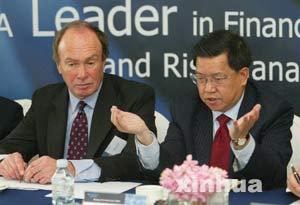
"China does not operate a competitive currency policy and its foreign exchange policy is transparent and consistent," said Desmond Supple, head of Asia research at Barclays Capital, the investment banking division of UK-based Barclays Bank PLC. He dismissed accusations that China has taken advantage of a cheap renminbi to become more competitive in trade. He told the conference that the Chinese Government's refusal to change its forex regime can be viewed as simply wanting to maintain the consistency of its currency just as it did during the 1997 Asian financial crisis. He added: "Any change of the renminbi regime has to go with the advancing process of China's financial reform." His words were echoed by Long Yongtu, secretary-general of the Boao Forum for Asia. "China's banking system reform is the premise of any economic reform," said Long. He said that foreign trade was not the only engine for China's economic growth. Economic reform, domestic consumption, and foreign trade and investment are the major driving forces of China's economic growth, he said. Long added that to liberalize the capital account, China must have a mature banking system, strong central bank supervision and a developed secondary financing market. "It is unlikely China would change its forex regime in the foreseeable future," Long said. "The country has to strike a balance between a more flexible forex regime and a largely stable one." Supple said the strong inflow of foreign speculative capital is also making it less possible for the Chinese Government to adjust its forex regime this year. "We see no evidence of any slowdown (of speculative capital inflow) in the first quarter of this year," Supple said. He added that China's forex reform requires the Chinese Government be confident that the country has achieved a soft landing from the 2002-04 investment boom and that the current problem of speculative capital inflow has been contained. However, the US Senate on Wednesday threatened to impose a punitive tariff of 27.5 per cent on imports from China, if the government does not adjust its forex regime within six months. Advocates of the policy said the renminbi is undervalued, which has disadvantaged US manufacturers and caused the large US trade deficit with China. |
|
|
|
|||||||||||||||
|
|
|
|
|||||||||||||||||