|
US companies play coy over China profits
By ANDREW BROWNE (Wall Street Journal)
Updated: 2006-02-13 12:01
HONG KONG -- American companies operating in China enjoyed another year of
strong profits in 2005, possibly even setting a record. But you would hardly
guess it from company statements or the negative vibes on trade with China
coming out of Congress these days.
Corporate America often seems to go out of its way to hide its successes in
China. That may not be the smartest strategy as U.S. politicians girding for a
possible trade war highlight the corporate losers of trade with China, while
ignoring the many winners.
According to the Bureau of
Economic Analysis, U.S.-affiliated companies in China -- companies in which U.S.
firms have at least a 10% stake -- earned $3 billion in 2004. That's up from
zero in 1990. Joseph Quinlan, chief market strategist for Bank of America, says
that figure is a good reflection of how U.S. companies are making out in the
world's fourth-largest economy. He estimates earnings reached a record $3.2
billion in 2005.
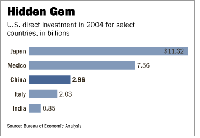
True, corporate profits from China accounted for just a sliver of the $209
billion earned by U.S. affiliates world-wide in 2004. Japan yielded $11.3
billion; Mexico, $7.6 billion. But China is becoming an increasingly attractive
market for U.S. companies, even in some of the most competitive industries.
Take the auto sector. As its losses piled up in the U.S., General Motors
Corp. reported income from China of $218 million for the first nine months of
2005. This nugget was buried in GM's filings to the Securities and Exchange
Commission.
China accounts for 12% of Motorola Inc.'s global sales and is by far the
biggest market for the company outside the U.S. The firm doesn't break out
income from China.
General Electric Co. said top-line revenue in China hit $5 billion last year,
and the company is aiming to double that by 2010. GE doesn't give profit
details, either.
Many U.S. companies unquestionably are making decent money in China. But
years of missteps and frustration -- and a few spectacular failures -- have left
a lingering impression that China is a black hole for investment.
Jonathan Woetzel, a director of McKinsey & Co.'s Shanghai office, recalls
making a speech 18 months ago to business executives in New York when he was
interrupted by Jack Welch. The former GE chief, clearly frustrated with the
skepticism about China he was hearing from the audience, rose to his feet and,
pointing at one executive after another, asked: "Are you making money in
China?...Are you making money?...Are you making money?"
Mr. Welch's spontaneous poll suggested that about 80% of companies
represented in the room were profitable.
At least some of these profits could become hostage to trade tensions.
Legislation proposed by Sen. Charles Schumer, a New York Democrat, would impose
a 27.5% tariff on Chinese goods unless Beijing lets its currency to rise faster
against the dollar.
After hearing Friday that the U.S. trade deficit with China ballooned to a
record $201.62 billion last year, Sen. Schumer said he may push for a Senate
vote on the bill next month. U.S. critics complain that the yuan remains
undervalued -- even after Beijing allowed it to appreciate 2.1% against the
dollar last summer -- making Chinese exports cheaper abroad. Beijing remains
adamant it will move at its own pace.
Not all U.S. firms would lose equally in a trade war. Contrary to popular
belief, relatively few come to China to make goods for export; the majority of
U.S. investment in China ($4 billion came in last year alone) is aimed at the
domestic market. McDonald's Corp. and Starbucks Corp. are in China pursuing
local yuppies.
Complex supply chains would make it hard for Beijing to retaliate against
U.S. businesses in China without causing collateral damage to its own and other
countries' companies. Nike Inc., for example, contracts out much of its
sport-shoe production to Chinese companies. Wal-Mart Stores Inc., which sourced
$18 billion of products from China in 2004, relies on local suppliers. In a
crisis, U.S. firms could quickly shift low-tech production to countries like
Vietnam or Mexico.
Still, U.S. businesses in China aren't immune to trade tensions. As they
lobby for market access in a heavily regulated economy dominated by state
companies, political good will is important. Even now, Citigroup Inc. is trying
to persuade Chinese regulators to bend the rules and allow it to take a
controlling share in a Chinese bank.
Given the stakes, why the coyness among U.S. companies in reporting success
in China?
One reason, says Emory Williams, president of the American Chamber of
Commerce in China, is that with all the negative publicity in the U.S. about
China linked to outsourcing and manufacturing-job losses, "it makes you
unpopular if you talk about doing well in China."
Economists warn that profit figures reported by multinationals should be
treated with caution. Much depends on where, for tax reasons, these companies
declare their earnings.
Still, it is hard to argue with the American Chamber of Commerce in China,
whose annual survey is one of the most reliable guides to the fortunes of U.S.
companies in the country.
Teresa Woodland, a Beijing-based consultant in charge of producing the
American Chamber guide, says her "gut feeling" is profit margins of U.S.
companies in China are running at 8% to 15%, though stiff competition may be
eating away at them.
|