|
Japan halts US beef again after mad cow violation
(Reuters)
Updated: 2006-01-21 08:51
Japan halted imports of U.S. beef on Friday just a month after lifting a ban,
following the discovery of spinal material in a shipment that should have been
removed due to the risk of mad cow disease.
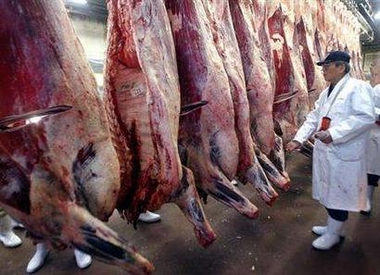
A Japanese meat
dealer examines Japanese cattle carcasses at a wholesale meat market in
Tokyo January 7, 2004. Japan has found risk material that could cause mad
cow disease in beef imported from the United States, a farm ministry
official said on Friday. [Reuters] |
U.S. officials immediately launched an investigation and ordered extra
training for all American meat inspectors, surprise inspections at plants
handling beef exports, and sent a team of experts to examine meat shipments now
held in Japanese ports.
"This is an unacceptable failure on our part to meet the requirements of our
agreement with Japan," Agriculture Secretary Mike Johanns told reporters.
U.S. cattle futures fell on the news. The February live cattle contract was
down 0.825 cent at 95.300 cents a pound in early trading on the Chicago
Mercantile Exchange.
Japan first stopped all purchases of beef from the United States after a case
of the brain-wasting mad cow disease in December 2003, halting annual trade
worth about $1.4 billion. The ban lasted two years and became an irritant in
otherwise close and friendly U.S.-Japan relations.
The latest incident, which also comes as U.S. Deputy Secretary of State
Robert Zoellick is due to visit Japan on Sunday and Monday, could alarm Japanese
consumers as well as raise questions about Tokyo's decision to lift the ban.
The Japanese Agriculture Ministry said the ban would remain until it receives
more information from the United States.
"It is regrettable that the United States has failed to abide by the
agreement," a farm ministry official told a briefing, referring to a deal in
October 2004 between Japan and the United States on the resumption of beef
imports.
"Any decision (to resume imports) would be after we receive information from
the U.S. government," the official said.
A total of 390 kg (860 lb) of beef imported from a meatpacker in New York was
found to contain parts of a spinal cord when it was inspected on arrival at
Narita International Airport near Tokyo, a Farm Ministry official said.
Experts believe humans can contract a fatal variant of mad cow disease,
formally known as bovine spongiform encephalopathy ( BSE), by eating
contaminated meat.
Another USDA official, speaking on condition of anonymity, insisted that
Japan has not formally reimposed its ban on U.S. beef. "Japan is putting a hold
on U.S. beef ... until they hear the results of the investigation," the official
said, adding that American shipments are being held at Japanese ports.
Japan imports only U.S. beef from cattle aged 20 months or younger. It
requires all animal material linked to mad cow, including the spinal cord, to be
totally removed.
Washington acted quickly to try to ease concern in what was the United
States' top overseas beef market prior to the ban.
A team of USDA meat inspectors will help re-examine every U.S. beef shipment
now awaiting entry "to confirm compliance" with the export requirements, Johanns
said.
Within the United States, two USDA inspectors instead of one will now be
required to review every shipment of beef to be exported to Japan, he said.
Japanese Prime Minister Junichiro Koizumi said earlier on Friday that
Agriculture Minister Shoichi Nakagawa wanted the United States to act firmly.
"He also recommended, because preserving food safety and security for the
people is extremely important, calling on the United States to make a strong
response," Koizumi told reporters.
Small quantities of beef from the United States have started to enter Japan,
but consumers remain worried that safeguards there are not up to Japanese
standards.
The U.S. beef industry acknowledged that a strong response was crucial to
help regain consumer trust.
"Japanese consumers are important to us. They are a key to our success," said
Jay Truitt of the National Cattlemen's Beef Association.
|