|
US tries to mark disputed African border
(AP)
Updated: 2006-01-10 08:58
The United States launched a diplomatic initiative Monday to try to mark the
contested border between Ethiopia and Eritrea, a dispute that led to a 2
1/2-year war in an area where both countries are again massing troops.
U.S. Ambassador John Bolton told the Security Council that a high-powered
U.S. delegation would travel to the region "to discuss how to begin
implementation of the demarcation process."
A December 2000 peace agreement that ended the border war provided for an
independent commission to rule on the position of the disputed 621-mile
boundary, while U.N. troops patrolled a 15-mile buffer zone between the two
countries.
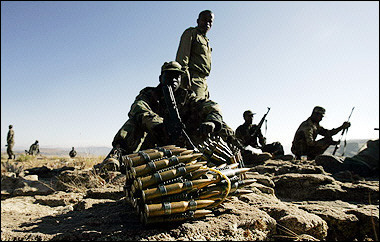
Ethiopian soldiers man an observation post
facing the Temporary Security Zone on the Eritrean border at the northern
town of Zala Anbessa in the Tigray region of Ethiopia, November
2005.[AFP/file] | But Ethiopia has refused to
implement the international boundary commission's April 2002 ruling, which
awarded the key town of Badme to Eritrea. Angry that the ruling was not
enforced, Eritrea in October banned U.N. helicopter flights and vehicle
movements at night on its side of the buffer zone. In December, the U.N. agreed
to its demand that Western peacekeepers leave the force monitoring Eritrea.
The Eritrean government gave no reason, but the pullout demand came amid
mounting concern that both sides were massing troops near the buffer zone as a
prelude to a new war.
Bolton announced the U.S. initiative at a closed-door Security Council
meeting on the future of the 4,000-strong U.N. peacekeeping force.
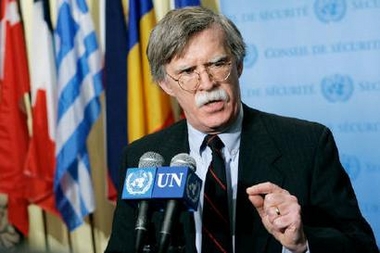
U.S. ambassador John Bolton seen speaking to
the media before the United Nations Security Council meeting in New York
City in this December 13, 2005 file photo.
[Reuters/file] | The U.S. ambassador said afterward that he asked the council to freeze the
current status of the U.N. force for 30 days "in order not to send any signals
politically or otherwise that might complicate" the diplomatic initiative.
Tanzania's U.N. Ambassador Augustine Mahiga, the current Security Council
president, said members agreed to keep the force's status quo for 30 days to
wait for the outcome of the U.S. initiative.
U.N. Undersecretary-General for Peacekeeping Jean-Marie Guehenno said there
was "a sense of urgency, of crisis" in the council "because, obviously, the
status quo is unsustainable." But he said the council recognized "that
everything has to be done to avoid increasing the risks on the front line
between Ethiopia and Eritrea, and so time has to be given for diplomacy."
Guehenno, who recently returned from the region, said "there is a need for a
real engagement by the international community." He called the U.S. decision to
send a high-powered mission not only important but "essential."
"The United States has solid relations with the two countries so it certainly
has the clout, the credibility to move the process forward," he said.
"This is a very difficult mission. There is never a certainty of success. But
I think it should be very much appreciated that the United States is prepared to
take the diplomatic risk, to engage itself, to move the region away from war,"
Guehenno said.
Everybody recognizes that the goal must be the demarcation of the border and
normalizing relations between the two poverty-stricken countries so they can
focus on development rather than spend money preparing for a possible war, he
said.
"How you get there is extremely difficult," Guehenno said.
The U.S. team traveling to the region in mid-January will be led by Assistant
Secretary of State for African Affairs Jendayi Frazer and retired Marine Gen.
Carlton Fulford, who directs the Africa Center for Strategic
Studies.
|