|
WTO agrees to end farm export subsidies
(Shanghai Daily/Agency)
Updated: 2005-12-19 09:02
Bringing a binding global trade treaty one step closer, WTO negotiators
approved a trade agreement yesterday that eliminates farm export subsidies by
2013 and makes modest cuts in other trade barriers, while leaving many
contentious issues for later.
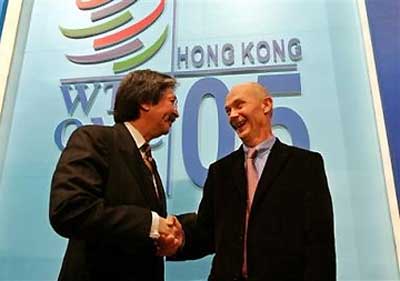
WTO
Director-General Pascal Lamy, right, and John Tsang, Hong Kong's Commerce
Secretary and chairperson of the 6th WTO Ministerial Conference
congratulate each other following the conclusion of the six-day summit
Sunday evening Dec.18, 2005 in Hong Kong.
[AP] |
Meeting in Hong Kong, all 149 member nations and territories of the World
Trade Organization endorsed the agreement after six days of talks that sometimes
appeared on the verge of collapse.
The agreement falls far short of the ambitious deal that WTO negotiators had
originally hoped for from the session: a detailed set of formulas for cutting
farm and industrial tariffs and subsidies. Toward that end, the text set April
30, 2006, as a new deadline to work out those details, required if the WTO is to
set a global free trade treaty by the end of next year.
The WTO made no immediate decision on the location and date of its next
ministerial meeting, leaving that decision to a later date.
Delegates managed a last-minute breakthrough on the thorny issue of farm
trade subsidies, with wealthy nations agreeing to eliminate the government
payments to promote exports like cotton and sugar by 2013.
The 2013 date was a key demand of the European Union, which faced intense
pressure from Brazil and other developing nations to end agricultural export
subsidies by 2010.
But in a compromise, the text included a provision that a substantial part of
the subsidies would go by "the first half of the implementation period" that the
text suggested would be set at a later date.
Although the agreement didn't reflect any outcome from negotiations on
industrial tariff cuts, it sought to take the process forward by addressing a
key concern of the poor countries. It said discussions on tariff cuts must
proceed in tandem with the progress made on the issue of granting flexibility to
poor countries in pursuing market opening policies.
It also linked negotiations on agricultural trade with those in industrial
goods in the hope that the move could help expedite progress in ongoing trade
talks and conclude these before end of next year.
In a victory for West African cotton-producing nations, rich countries agreed
to eliminate all export subsidies on cotton in 2006.
Under the agreement, wealthy nations must allow duty-free and quota-free
privileges for at least 97 percent of products exported by the so-called least
developed countries, those with per capita incomes of less than US$750 a year,
by 2008.
Agencies
|


