|
Mascots promise a 'friendly' Olympics
By Lei Lei and Sun Xiaohua (China Daily)
Updated: 2005-11-12 06:32
Beijing has unveiled its five 2008 Olympic mascots the Five Friendlies to
coincide with the 1,000-day countdown to the big event.
It is the first time in Olympic history that five mascots have been chosen.
Each mascot has a rhyming two-syllable name, the traditional way of
expressing affection for children in China. Beibei is the Fish, Jingjing is the
Panda, Huanhuan is the Olympic Flame, Yingying is the Tibetan Antelope and Nini
is the Swallow.
The first characters of their two-syllable names read "Beijing Huanying Ni,"
or, in English, "Welcome to Beijing."
"The mascots are a special gift that Beijing presents to the world and to the
Olympic Movement," said Liu Qi, president of the Beijing Organizing Committee
for the Games of the XXIX Olympiad (BOCOG).
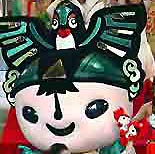 During a gala show on Friday evening, huge inflated cartoon figures of the
mascots walked on stage amid a standing ovation from the audience in the
Workers' Stadium. During a gala show on Friday evening, huge inflated cartoon figures of the
mascots walked on stage amid a standing ovation from the audience in the
Workers' Stadium.
The mascots, together with the official emblem and slogan of the 2008 Games,
express Chinese people's wishes for peace, friendship, progress and harmony, Liu
said.
The mascots have distinctive Chinese characteristics, representing not only
the multi-ethnic cultures of China, but also the traditional Chinese philosophy
of harmony between humans and nature, Liu noted.
Chosen in line with the colours of the Olympic Rings, they embody the
landscape, dreams and aspirations of people from every part of China.
They also represent the five elements of nature the sea, forests, fire, earth
and sky all stylistically rendered in ways that reflect the deep traditional
influences of Chinese folk art and ornamentation.
"Five" also matches the five elements (metal, wood, water, fire and earth)
believed by ancient Chinese people to explain the origins of the world.
Jacques Rogge, president of the International Olympic Committee (IOC), sent a
congratulatory letter to the BOCOG saying China was "lucky to have so many
beautiful animals to represent the Olympic spirit. I love them all. I believe
that this little group of friends ... will be extremely popular and will help to
spread Olympic messages throughout the world."
He added in the letter: "You've certainly touched my heart with your choices.
And I'm sure the Five Friendlies will touch the heart of the world."
"The mascots are very cute and very creative," said Luo Yuan, an English
teacher at Nanjing University of Technology in Jiangsu Province, East China.
"I like the yellow and red ones (the antelope and flame)," said Ning
Chengzhe, a six-year-old pupil in Zhengzhou, the capital of Henan Province,
Central China.
But Wang Bin, a bank employee in Beijing, said there were too many mascots
and they were "hard to remember."
The "Five Friendlies" combine human and animal images. It is the first time
an Olympic element, the Olympic flame, has been included in the mascots.
The 2000 Sydney Games featured three animal mascots Olly the Kookaburra, Syd
the Platypus and Millie the Spiny Anteater.
The first mascot to appear at an Olympics was during the 1968 Winter Games in
Grenoble, France, although Schuss the skier was not official. The first official
mascot was Waldi the Dachshund, who appeared at the Munich Summer Games in 1972.
Since then, the mascots have become a main element of the Olympic image. They
have acted as a vehicle to convey the Olympic spirit to the general public,
especially to children.
The "Five Friendlies" and other Olympic mascot merchandise will be on sale in
authorized outlets in Beijing and other major Chinese cities.
"The launch of the mascot will bring sales of Olympic products to new
heights," said Lai Ming, deputy director of the Marketing Department of BOCOG.
He believed the sales volume will be bigger than in previous Olympic Games.
Competition was hot with 662 entries, of which 611 were from the Chinese
mainland, 12 from Hong Kong, Macao and Taiwan, and 39 from abroad. Many places
wanted their local symbols picked as mascots.
China's western Qinghai Province pushed hard for the endangered Tibetan
antelope, Fujian Province touted the South China tiger, Gansu favoured the
mythical dragon and Jiangsu promoted the legendary Monkey King.
(China Daily 11/12/2005 page1)
|