|
US takes patient tack on yuan policies
By Neil King Jr (Wall Street Journal)
Updated: 2005-10-10 10:43 Despite signs of mounting impatience, Treasury officials argue in public that
China is still getting acquainted with the complexities of its new system, and
can't be expected to take leaps right away. "They are going through a period of
self-education about how the system works," Mr. Adams said. To emphasize that
point, Mr. Snow plans to make one of his first stops at China's interbank
foreign-exchange market in Shanghai.
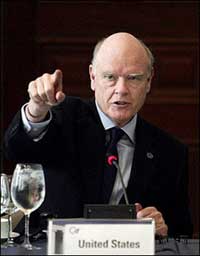
US Treasury
Secretary John Snow, pictured September 2005, will arrive in China October
11 for his first visit in two years, the tussle over the yuan is
again taking center stage. [AFP
file] | Beijing bent to years of international pressure in July when in one day it
nudged the yuan up by 2.1% against the dollar. Mr. Snow applauded the move as a
good first step but made clear that the U.S. expected bigger moves in the near
future. Under the new system, China lets the yuan -- which uses a basket of
currencies as a reference -- move 0.3% a day either way against the dollar. But
since the revaluation the yuan's value against the dollar has gone up by only
0.16%.
The yuan strengthened in special weekend trading sessions in Shanghai
following a weeklong holiday. The dollar ended at 8.0876 yuan yesterday, down
from 8.0920 yuan Sept. 30, its last trading session before the National Day
holiday.
China has taken some small steps toward greater flexibility since July, and
its central-bank governor said last week that Beijing should re-examine the
yuan's value in light of the country's swelling trade surplus. Still, Chinese
officials remain adamant that increased currency flexibility must come slowly,
and that a fully convertible yuan is at least five years away. Chinese officials
point to the havoc of the 1997 Asian financial crisis, when both Korea's and
Thailand's currencies plunged amid rampant speculation.
The Bush administration faces a decision in coming weeks over whether to
label China a "currency manipulator" in the Treasury's semiannual currency
report, due out in early November. That designation, which many in Congress and
within US industry have demanded for at least two years, would prompt talks
between the US and China and could lead to sanctions.
Mr. Adams said the Treasury was just beginning to write the report,
originally due October 15, and that any conclusions would depend in part on what
assurances the US delegation receives while in China.
Not labeling China a manipulator could invoke a swift response from Congress,
where Sens. Charles Schumer, a New York Democrat, and Lindsey Graham, a South
Carolina Republican, say they are poised to bring to the floor their bill to
impose 27.5% tariffs on Chinese imports unless Beijing lets its currency
appreciate further.
Many economists say it is only a matter of time before market forces compel
the Chinese to alter the value of the yuan. With its own imports now lagging,
China this year is on course to accumulate a total current-account surplus with
the rest of the world of about 8% of its own annual economic output -- a figure
that would normally put enormous upward pressure on any free-floating currency.
|