|
Home>News Center>Bizchina | |
|
|
|
|
|
|
|
|
|
|
||||||||||||||||||||||||
|
|
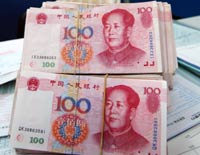
Central bank to gradually lessen forex role China's central bank will "gradually" lessen the degree to which it intervenes in foreign exchange markets, but is not certain the country's yuan currency is undervalued, a senior central bank official said in an interview published on Thursday.
"The frequency and level of such interventions will be gradually decreased," she said. But Hu, who is also China's foreign exchange chief, added: "We think it's still an open question as to whether the (yuan) exchange rate is undervalued." In July, China ditched a decade-old policy of pegging the yuan to the U.S. dollar, revalued it by 2.1 percent and moved instead to a managed float. The move has been welcomed by the United States as a welcome first step toward greater currency flexibility. But the United States, which has argued an undervalued yuan gives China an unfair advantage in world markets, has said further steps are needed. The topic is expected to be on the table on Friday when officials from China and fellow emerging markets Brazil, Russia, India and South Africa sit down with central bankers and finance ministers from the rich Group of Seven countries for a working luncheon ahead of a formal G7 gathering. The G7 -- the United States, Britain, Canada, France, Germany, Italy and Japan -- has called for greater currency flexibility in recent post-meeting communiques and faces a delicate task in deciding how to treat the issue in the wake of China's July 21 move. The revaluation took the yuan from 8.28 to the dollar to 8.11. But the currency has moved up only a further 0.27 percent in the two months since the revaluation, a sign the central bank is keeping it on a tight leash. "We can't expect the move will change the activity or strategy of the (central bank) in the foreign-exchange market overnight," Hu told the publication. She said China still needed to take steps to ensure speculative inflows do not destabilize the economy. "We should first further develop our capital markets and other domestic institutions, to better use our domestic market to finance business," she said. "We have to implement all kinds of control on this hot money. We have to keep our watch on capital inflows." "We've repeated this many times: a stable exchange rate is in China's best interest," Hu said. |
|
|
|
|
|||||||||||||||||||||
|
|
|
|
||||||||||||||||||||||||
 "Gradually the (People's Bank of China) will carry out fewer and fewer
interventions in the foreign exchange market and let the market decide," Hu
Xiaolian, deputy governor at the central bank, told the publication "Emerging
Markets."
"Gradually the (People's Bank of China) will carry out fewer and fewer
interventions in the foreign exchange market and let the market decide," Hu
Xiaolian, deputy governor at the central bank, told the publication "Emerging
Markets."