|
Home>News Center>Bizchina | |
|
|
|
|
|
|
|
|
|
|
|||||||||||||||||||
|
|
Debates to centre upon tax reforms
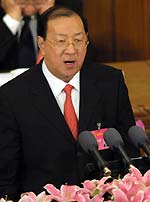
Finance Minister Jin Renqing and the nation's taxation chief Xie Xuren should expect to be deluged with questions on reforming China's taxation system when they go before a press conference set for this afternoon.
The debate did not generate results last year. So it is just natural that tax reform is among the hottest of topics during the ongoing session of the National People's Congress (NPC) and the Chinese People's Political Consultative Conference (CPPCC). Dozens of formal proposals and speeches have been centring on the topic. In addition to reforming the corporate income tax system, NPC deputies and CPPCC members have urged a more just personal tax system to be established, along with the enactment of a Taxation Code, in effect a basic law for taxation. China's tax collectors now follow the 1991 Foreign-funded Enterprise and Foreign Enterprise Corporate Income Law, which stipulates a 15 per cent rate for such firms, and the 1993 Provisional Rules on Corporate Income Tax, which set a 33 per cent rate for enterprises funded wholly by domestic investors. "The difference unfairly put domestic enterprises at a disadvantageous position in competing with foreign peers," said Xu Yulin, a CPPCC member and deputy director of the State Council's Legal Office. In addition, tax experts said in an era when tax reductions are the trend, the 33 per cent should also be cut. Xu said relevant departments have drafted a plan for unifying policy, with a single rate of around 25 per cent. That rate is at the middle-range among rates adopted by other countries. The plan also proposes a transition period of between two or three years to help foreign-funded firms adjust to the new taxation level. However, the plan has met with strong opposition from those who say a unified rate will dampen foreign investment growth. They worry that China will become less competitive when many Asian neighbours are trying harder to attract overseas investors. David Dollar, director of the World Bank's China Programme, said the opponents' argument is not valid. It is necessary and understandable to have preferential tax rate for foreign companies when market conditions are not very competitive, he said. But the preferential rate for foreign companies has increasingly become inappropriate as China's investment climate has substantially improved. "Increasingly it (the dual corporate income tax system) does not make sense," he said. Taxation is not very important when attracting investors, who now pay more attention to the overall investment environment, which include infrastructure and government efficiency, he said. Compared to neighbouring countries, China looks pretty good in this regard, he said. Meanwhile, the focus of the public's debate is on the 800 yuan (US$96) threshold for personal income tax payments. It was set in 1980, when the current Personal Income Tax Law was promulgated. The economic situation is enormously different today than two decades ago. So all agree the threshold should be raised. However, experts say reforming personal income taxes should include far more than raising that level. What is more important is a better collection system and to have more deduction designs for such people as the disabled and those who fianncially support others to make the system promote social justice. Personal tax collection now relied heavily on companies and institutions that have property accounting systems. Their treasury staff is commissioned to collect taxes. But those who obtain part of their income from other channels in many cases high-income earners can cheat the system by avoiding taxes due. "So we really need a system that can trace personal incomes," said Yang Zhigang, a senior fiscal science researcher at the Chinese Academy of Social Sciences. Yang also said the country needs a basic law for taxation to clearly state the key principles in the sector. Yang also said tax reforms should be carried when China's tax revenues grow rapidly because that will make the reforms easier to complete.
(China Daily 03/09/2005 page3) |
|
|
|
|
||||||||||||||||
|
|
|
|
|||||||||||||||||||