|
Home>News Center>Life | |
|
|
|
|
|
|
|
|
|
|
||||||||||||||||||||||||||||||||||||||||||||||||||||||||||||||||||
|
|
Many amphibians threatened worldwide
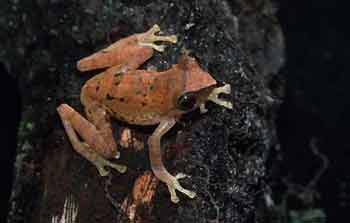
Eye of newt and toe of frog may one day be gone from witches grog. Indeed, not just frogs and newts but amphibians in general are rapidly becoming threatened worldwide, a new study shows.
And while few would miss the evil broth concocted by the witches in Shakespeare's Macbeth, the rapid decline of animals like toads and salamanders is raising concerns as it worsens, a team of researchers reported Thursday.
These declines are "outside our normal experience," Stuart said in a telephone interview.
There are a variety of reasons for some losses, while others remain a mystery, the group reports in a paper being published online by the journal Science.
Amphibians have porous skins and narrow environmental requirements, and their decline may be an indication that something sinister is under way in the environment, Simon said.
"Where amphibians proceed, others may follow, possibly us also," he said.
The researchers reported that 1,856 species, 32.5 percent of the known species of amphibians, are "globally threatened," meaning they fall into the International Union for the Conservation of Nature's categories of vulnerable, endangered or critically endangered. By comparison, 12 percent of bird species and 23 percent of mammal species are threatened.
The researchers reported 435 amphibian species are in rapid decline, at least nine species have gone extinct since 1980 and another 113 species have not been reported from the wild in recent years and are considered to be possibly extinct.
Their findings, called the Global Amphibian Assessment, were compiled by more than 500 scientists in 60 countries.
"All in all, amphibians are certainly in deep trouble in many areas, for a whole suite of reasons," said Ross A. Alford, a professor of tropical biology at James Cook University in Australia.
Alford, who was not a co-author of the report, said via e-mail that the study "has done a good job of documenting (the decline), and also of pointing out how much more we need to know to really understand the scale of the problem and begin to attempt to solve it."
Indeed, he added, the report may even understate the problem due to the patchiness of knowledge of amphibians.
"It is quite possible that there are as-yet large-scale ... declines, similar to those that have been documented for Australia and the New World tropics, that are occurring or have occurred" elsewhere, said Alford, author of a 1999 study of amphibian decline.
Trevor Beebee of the University of Sussex in England added that amphibians may be a type of warning, like the canaries miners used to take with them because the birds are more sensitive than people to the dangerous gasses that can occur in mines.
"In my view this assessment of amphibian declines is very important, because it quantifies an extremely worrying set of observations," Beebee said via e-mail. "Amphibians are declining in many places all over the world, often in areas where we might expect human effects to be minimal."
The new paper concludes that while exploitation and loss of habitat are factors in some losses, other declines remain enigmatic, occurring for unknown reasons.
Overexploited species are concentrated in East and Southeast Asia where frogs are harvested for food, the report says. Habitat loss occurs more widely, but especially in Southeast Asia, West Africa and the Caribbean, it adds. A major concern, the researchers say, are the enigmatic declines and disappearances occurring in North and South America, Puerto Rico and Australia. "Such declines have taken place even within well-protected areas, such as Yosemite National Park (California), Monteverde Cloud Forest Preserve (Costa Rica) and Eungella National Park (Australia)," the researchers wrote. Some studies have associated these unexpected declines with a fungal disease that tends to occur at higher elevations and streamside locations, the report notes. Beebee also suggested subtle effects of climate change may also be at work. Funding for the Global Amphibian Assessment was provided by the Moore Family Foundation, Gordon and Betty Moore Foundation, Conservation International, MAVA Foundation, U.S. State Department, Regina Bauer Frankenberg Foundation for Animal Welfare, National Science Foundation, Critical Ecosystem Partnership Fund, television producer George Meyer, conservation supporters Ben and Ruth Hammett and the Disney Foundation.
|
|
|
|
|
|||||||||||||||||||||||||||||||||||||||||||||||||||||||||||||||
|
|
|
|
||||||||||||||||||||||||||||||||||||||||||||||||||||||||||||||||||