|
Home>News Center>World | |
|
|
|
|
|
|
|
|
|
|
||||||||||||||||||||||||||||||||||||||||||||||||
|
|
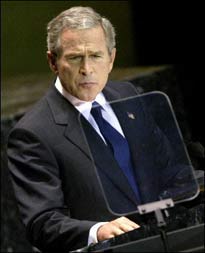
Bush defends decision to oust Saddam
US President Bush delivered an unapologetic defense of his decision to invade Iraq, telling the United Nations Tuesday that his decision "helped to deliver the Iraqi people from an outlaw dictator." He appealed to the world community to join together in supporting the new Iraqi interim government.
Bush's speech to the U.N. General Assembly, running just 24 minutes, also included an appeal for intensifying the global war against terrorism and for focusing energies on humanitarian missions, from helping to end the bloody violence in Sudan to combating AIDS in Africa.
He spoke shortly after U.N. Secretary-General Kofi Annan opened the 191-nation gathering with a warming that the "rule of law" is at risk around the world. Annan last week asserted that the U.S.-led invasion of Iraq "was illegal" because it lacked such Security Council approval.
"No one is above the law," Annan said. He condemned the taking and killing of hostages in Iraq, but also said Iraqi prisoners had been disgracefully abused, an implicit criticism of the U.S. treatment of detainees at Abu Ghraib prison near Baghdad.
Bush told a subdued U.N. session that terrorists believe that "suicide and murder are justified ...And they act on their beliefs." He cited recent terror acts, including the death of children earlier this month in their Russian school house.
"The Russian children did nothing to deserve such awful suffering and fright and death," the president said.
Bush reached out to the international organization to help with the reconstruction of Iraq, noting that the prime minister of Iraq's interim government Ayad Allawi was among those attending the session.
"The U.N. and its member nations must respond to Prime Minister Allawi's request and do more to help build an Iraq that is secure, democratic, federal and free," he said.
"A democratic Iraq has ruthless enemies," Bush added, asserting that "a terrorist group associated with Al Qaida is now one of the main groups killing the innocent in Iraq today, conducting a campaign of bombings against civilians and the beheadings of bound men."
Bush made specific reference to Monday's beheading of an American civil engineer. "We can expect terror attacks to escalate" as elections approach in both Afghanistan and Iraq, he said.
"We will be standing with the people of Afghanistan and Iraq until their hopes for freedom and liberty are fulfilled," Bush said.
Six weeks before Election Day, Bush's comments were directed as much to his audience at home as to the assembled U.N. delegates. His Democratic rival, John Kerry, has accused him of "stubborn incompetence" and "colossal failures in judgment" on Iraq policy and of having squandered international good will.
Bush's speech included an appeal for more humanitarian involvement, ranging from helping to end the bloody conflict in Sudan to fighting AIDS in Africa. "AIDS is the greatest health crisis of our time and our unprecedented commitment will bring new hope to those who have walked too long in the shadow of death," he said.
With the casualty toll in Iraq still rising and with a rash of recent suicide attacks, Bush did not dwell on his decision to lead the invasion of Iraq. But he suggested that the Security Council had not followed through after it "promised serious consequences" for Saddam's defiance.
"The commitments we make must have meaning. When we say serious consequences, for the sake of peace there must be serious consequences. And so a coalition of nations enforced the just demands of the world," Bush said.
"My nation is grateful to the soldiers of many nations who have helped to deliver the Iraqi people from an outlaw dictator," he said.
Bush's remarks drew applause only once — at the end of his speech. He also told the gathering he was proposing a "democracy fund" within the United Nations which he said would help countries lay the foundations of democracy by instituting the rule of law, independent courts, a free press, political parties and trade unions. "Money from the fund would also help set up voter precincts and polling places and support the work of election monitors," he said. Bush said the United States will make an initial contribution. "I urge all other nations to contribute as well," he said. On Iraq, Richard Holbrooke, U.N. ambassador during the Clinton administration, said on NBC"s "Today" show Tuesday, said the goals that Bush has articulated for the new Iraq "are things that this administration has proved incapable of achieving." Appearing on the same show, national security adviser Condoleezza Rice claimed progress despite the recent wave of car-bombings and hostage-takings. She said "there's no evidence" that Iraq is falling into a state of civil war and said things are better than three months ago even though the Iraqi people "are facing a very tough and daring insurgency." Secretary of State Colin Powell, interviewed Tuesday on ABC's "Good Morning America," called the situation "a difficult struggle" but said "to say we can't deal with it, this sort of attitude that we're on the verge of defeat is absolutely wrong." Bush's U.N. speech was sandwiched between meetings with world leaders — and a sit-down with Annan. It is an unusual burst of diplomacy for Bush, who has been keeping a punishing travel schedule to swing states as he seeks re-election. Also Tuesday, Bush met with the leader of India, and was to sit down later with the heads of Pakistan, Afghanistan, Japan and Iraq. Last year, Bush met with the leaders of France and Germany — two of his harshest critics on Iraq. But there are no Europeans on this year's list, and aside from his host, Annan, no sharp critics of the Iraq war. |
|
|
|
|
|||||||||||||||||||||||||||||||||||||||||||||
|
|
|
|
||||||||||||||||||||||||||||||||||||||||||||||||