|
Home>News Center>Bizchina | |
|
|
|
|
|
|
|
|
|
|
|||||||||||||||||||
|
|
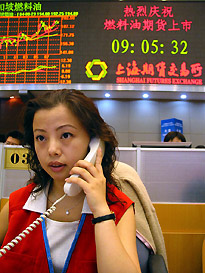
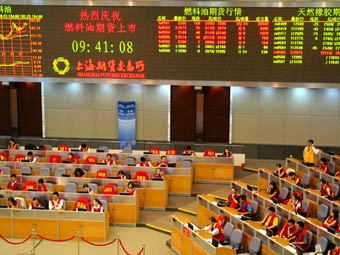
Oil futures trading restarts Trading in fuel oil futures started in Shanghai Wednesday after a 10-year break, giving the world's second-largest oil consumer a important tool with which to hedge risks.
As the world's second-largest oil consumer and third-largest importer, China's oil consumers have long expected oil futures to hedge risks. China Securities Regulatory Commission (CSRC) Chairman Shang Fulin said the nation should speed up the establishment of an oil risk hedging mechanism, with fuel oil futures being just the start. Fuel oil futures were the first product approved by the authority since 1994, when regulators shut down the over-speculated futures market. Experts also point out that fuel oil is the most liberalized oil product, which makes it first to hit the board. Shang said: "The fuel oil futures provide enterprises a platform to grasp the pricing information in the market while hedging risks. "It will also help to generate more experience and future complete oil market mechanism," he added. Fuel oil is mainly used in power generators, transportation and industrial manufacturing. China consumed around 44 million tons of fuel oil last year, compared with 3.44 million in 2002, according to an SHFE report. About half of this fuel oil was imported.
China has also witnessed a sharp decline in fuel oil production. Domestic output fell 38.68 per cent since 1990 to 20 million tons last year. But imports skyrocket 36 times from 650,000 tons in 1990 to 23.78 million tons last year, meaning half of domestic fuel oil consumption rely on imports. About 80 per cent is from neighbouring countries including South Korea, Singapore and Russia. However, without fuel oil futures, domestic users can do little to hedge their risks to deal with price volatility. Moreover, the lack of fuel oil futures puts China at an disadvantage in terms of pricing. Both the regulator and the exchange are taking a cautious approach to the new derivatives. Shang said China's futures market is still at an early stage and is emerging and transforming market. "It will take a lot of cultivation and effort to make a product mature after its launch. We need to have a sufficient understanding and preparation for the possible problems," he said at the launch ceremony of the new product, adding that rigid risk control is critical to the process. Traders should have 8 per cent reserves, higher than the normal 5 per cent set for copper and aluminum. The fluctuation is set within 5 per cent. Traders welcome the new contracts. "Many power plants and other oil consumers are interested in fuel oil futures," said Wang Jianguo, general manager of Tongbao Futures Brokerage. "But they are not clear about how to use the derivative to hedge risks," he added. |
|
|
|
|
||||||||||||||||
|
|
|
|
|||||||||||||||||||