|
Home>News Center>World | |
|
|
|
|
|
|
|
|
|
|
||||||||||||||||||||||||||||||||||||||||||||||||
|
|
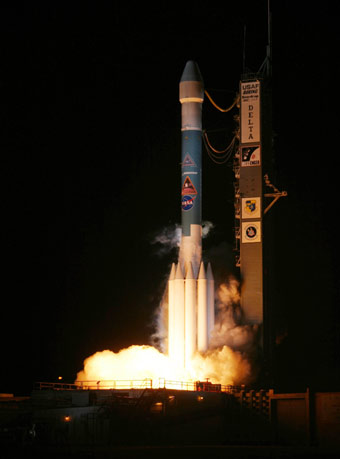
NASA launches spacecraft to Mercury NASA launched a messenger to Mercury on Tuesday, the first spacecraft in 30 years to head to the sun's closest planet.
The probe, named Messenger, rocketed away in the in the pre-dawn moonlight on what will be a 8 billion kilometer (5 billion-mile), 6 1/2-year journey to Mercury. The trip should have started a day earlier, but clouds from Tropical Storm Alex postponed liftoff.
If all goes well, come 2011, Messenger will be the first spacecraft to orbit Mercury. The spacecraft cannot fly straight to Mercury; it does not carry nearly enough fuel. So it will fly once past Earth, twice past Venus and three times past Mercury -- and make 15 loops around the sun -- before slowing enough to slip into orbit around the small, hot planet. Its seven scientific instruments will collect data for a full year in orbit around Mercury, an average 58 million kilometers (36 million miles) from the sun. That's 2 1/2 times closer to the sun than Earth -- it would be as though 11 suns were beating down on Earth. Messenger will be blasted by heat up to 370 Celsius (700 Fahrenheit) heat once it reaches Mercury, but its instruments will operate at room temperature, protected by a custom-built ceramic-fabric sunshade just 64 millimeters (one-quarter of an inch) thick. All Mariner 10 had was a quaintly old-fashioned umbrella. That's why, in large part, it's taken so long to return to Mercury. Scientists had to figure out how to beat the heat. Technology and opportunity converged only recently via NASA's low-cost, planetary-science Discovery program. The entire tab for the Messenger mission, developed and run by Johns Hopkins University, is US$427 million. Mariner 10 provided "a glimpse of this planet of extremes," said Orlando Figueroa, director of NASA's solar system exploration division. Because it only flew by Mercury and did not circle the planet, Mariner 10 observed less than half the orb. Messenger will view Mercury from all sides. "I say we are long overdue for another visit with some permanence to help us unveil the secrets of this planet, the innermost and least understood of the terrestrial planets," Figueroa said. |
|
|
|
|
|||||||||||||||||||||||||||||||||||||||||||||
|
|
|
|
||||||||||||||||||||||||||||||||||||||||||||||||