|
Home>News Center>Life | |
|
|
|
|
|
|
|
|
|
|
||||||||||||||||||||||||||||||||||||||||||||||||
|
|
Humans traded weaker jaws for big brains
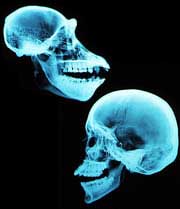
A genetic mutation that occurred 2.4 million years ago could be the reason why modern humans have such big brains and weak jaws, scientists said on Wednesday, March 24.
But the trade-off was a smaller, less powerful jaw.
"The coincidence in time...may mean that the decrease in jaw muscle size and force eliminated stress on the skull which released an evolutionary constraint on brain growth," said Nancy Minugh-Purvis, a member of the team at the University of Pennsylvania School of Medicine, that made the discovery.
All humans have the MYH16 mutation but other primates, including chimpanzees and macaques, still have the intact gene. Over the past few million years, since the genetic fault occurred, human skulls have grown three times in size and the outwardly elongated jaws have receded.
Pete Currie, of the Victor Chang Cardiac Research Institute in Sydney, believes the research published in the science journal Nature could be the first functional genetic difference between humans and apes.
"Remarkably, the timing of the appearance of this genetic alteration, or mutation, roughly coincides with the appearance of "human-like" characteristics in the hominid fossil record," Currie said in a commentary in the journal.
Minugh-Purvis along with Hansell Stedman and other experts at the university pieced together the complicated puzzle after discovering that the gene was intact in primates but mutated in all humans.
A genetic fault is often linked with some type of inherited disease but the scientists were puzzled about what type of disease was common in all humans throughout the world.
Further research revealed that MYH16 was associated with muscles involved in chewing and biting and it encoded a protein in primate jaw muscles. This led the researchers to suspect the so-called disease in humans was a weaker bite.
Stedman and his colleague said the weaker bite would have lessened the force on the skull so it could grow larger and provide more space for a bigger brain.
"We can only hope that this study represents the vanguard of a new wave of analyses that focus on the genetic basis of human evolution," Currie added.
|
|
|
|
|
|||||||||||||||||||||||||||||||||||||||||||||
|
|
|
|
||||||||||||||||||||||||||||||||||||||||||||||||