|
Home>News Center>Bizchina | |
|
|
|
|
|
|
|
|
|
|
|||||||||||||||||||||||||||||
|
|
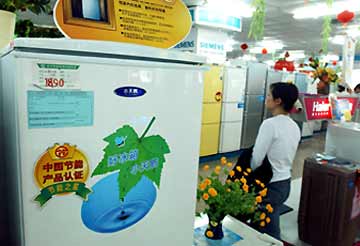
Firms switch on to energy-saving items China's large-scale power shortages has driven more domestic firms to develop, manufacture and market more power-saving household electric appliances. Last month, Shinco, which is devoted to the development of power conservation technology, launched its "saving electricity in households" campaign. The company has invested a total of 50 million yuan (US$6 million) to market 50,000 sets of frequency-conversion air conditioners with an average price cut of 33 per cent. Hisense also announced last year it will continue focusing on the development of power-saving technology. "Energy conservation will definitely be a future trend for the development of electrical home appliances, even if power supplies are sufficient," said Luo Qingqi, a senior consultant at the Pully Consultant.
According to latest State Council statistics, China's gap between power supply and demand currently exceeds 10 million kilowatts. And power shortage will remain serious this year in some regions, affecting both economic development and residents' daily lives. Home electrical appliances like refrigerators and air conditioners are widely considered as big power consumers, analysts say. Statistics show that the country has at least 130 million refrigerators, consuming nearly half of all residential power supplies. And air conditioners eat up more than 40 billion kilowatts-hour every year, a figure which is set to rise. "The high power consumption of home appliances affects the country's power supply, whereas, the power shortage also has a negative impact on the development of the home appliances industry," Luo said. Most domestic home appliance producers have been focusing on the development of new technology to increase efficiency, helping to secure a more sustainable development. The most prevalent and the best way currently is to adopt frequency-conversion technology, Luo added. It is estimated that if all the old fridges are changed to frequency-conversion ones, power consumption will fall by 20 per cent annually, saving 120 billion kilowatts-hour of electricity in 15 years. If all households used frequency-conversion air-conditioners, with their 30 per cent higher ratio of efficiency, the country could save 48 billion yuan (US$5.8 billion) a year. This higher efficiency will not only ease the country's power shortage, but also benefit consumers. For families which own three air conditioners and operate them for an average of three hours a day, 2,000 kilowatts-hour of electricity, or an electricity fee of some 1,000 yuan (US$120) will be saved annually per household. "Compulsory requirements on the limitation of power consumption should be applied as soon as possible, to promote frequency-conversion products," Luo said. He expects that the frequency-conversion products will account for over 50 per cent of the market in three years' time. The figure currently stands at less than 20 per cent, compared with a more than 95 per cent in Japan, and around 50 per cent in Europe. A new criteria regarding the limitation of power consumption and efficiency rating systems for refrigerators was put into effect last November. However, the specific rule is still awaiting approval. And a power consumption requirement for air conditioners is likely to be issued this year. It is reported that the old requirement of energy-efficiency ratio would be raised. "It is an urgent requirement to issue the compulsory certification mark of energy efficiency for home appliances," said Wang Lei, vice-secretary-general of the China Household Electrical Appliances Association. |
|
|
|
|
||||||||||||||||||||||||||
|
|
|
|
|||||||||||||||||||||||||||||