|
Home>News Center>Bizchina | |
|
|
|
|
|
|
|
|
|
|
||||||||||||||||||
|
|
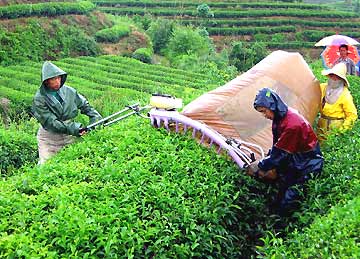
Firm mulls over tea business spin-off China National Native Produce and Animal By-Products Import and Export Co (China Tuhsu), a top State-owned agricultural trading company, is considering listing part of its businesses both at home and abroad to enhance its competitiveness, company sources have revealed. The company is also revving up efforts to seek a larger presence in the modern agricultural sector to retain its leading market position, according to President Pan Deyuan. "We are in pursuit of going public, and now China Tuhsu is seeking strategic partners globally," Pan said. The ambitious president is thinking about spinning off its tea business, a traditional core business for China Tuhsu, or its newly engaged agricultural processing business, which the company finds promising and is pressing ahead with listing them "at a proper time."
Its tea trading is mainly conducted through its China Tea Co subsidiary, formerly China Tea Import and Export Co, a State-designated company that is certified to export green tea and oolong tea. Native products such as flowers and timber, animal by-products such as feathers and leather, and the tea business are the three traditional pillars of the company. "China Tea is one of the candidates we are considering listing," Pan said. He added that China Tuhsu has long been thinking of restructuring China Tea. Another choice for Pan is to spin off its agricultural processing businesses, which the company defines as a new pillar and vows to give top priority to in the coming years. China Tuhsu plans to package its processing businesses to form a new company, he said. These businesses include a rosin processing project in South China's Guangdong Province, a tea refinery, and a venture dedicated to the modernization of chrysanthemum growing in northern Hebei, and eastern Shandong and Fujian. "And more projects are coming," Pan said. Pan said his company is also considering entering into the flower species developing business. "All of these new businesses are high-tech and export-oriented," Pan said. He believes these newly developed businesses are in the best interests of his company. China Tuhsu plans to invest US$6 million into establishing a joint venture factory this year in Gaoyao of Guangdong to process rosin with high-tech equipment. The factory will be able to process 30,000 tons of rosin within three years, Pan said. The project will also be conducive to increasing the incomes of local rural workers. Each of the 400,000 rural families in that area is expected to earn another 1,000 to 3,000 yuan (US$121-US$363) annually, a local government official said. And Pan is confident that the newly-established chrysanthemum bases will be able to export 100 million chrysanthemums to Japan at a price ranging from 10 to 12 yuan (US$1.21-US$1.45) per package in the coming two to three years. "I think the chrysanthemums we plant will be competitive," Pan believed. China Tuhsu is one of China's trading titans, having sped up efforts to widen its business scope from trading to industries to meet what it expects to be fiercer competition in the trade sector, analysts say. According to China's World Trade Organization (WTO) pledges, the country will begin granting foreign trade rights to companies in which foreign investors hold majority shares in the third year of its WTO membership, namely 2004. "Foreign trade is no longer the privilege of State monopolies," said Fan Ying, a trade expert from the Foreign Affairs College in Beijing. "State-owned trading enterprises should readjust their development strategy to find a way out. "China Tuhsu is wise to choose a field (modern agriculture) that it is familiar with." The company notched a trade volume of US$483 million in 2003, remaining top among China's agricultural traders. |
|
|
|
|
|||||||||||||||
|
|
|
|
||||||||||||||||||