Greenspan: Pricier Yuan won't help US trade deficit
( 2003-12-12 09:47) (Agencies)
US Federal Reserve Chairman Alan Greenspan on Thursday challenged what he called the "conventional wisdom" that China's "manipulation of its currency" has given that country a huge competitive advantage against American companies that has cost thousands of American jobs.
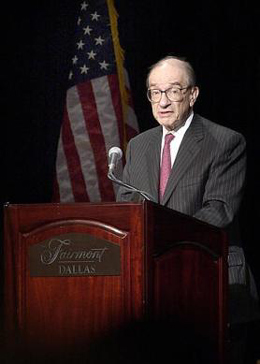 "The story on trade and jobs, in my judgment, is a bit more complex, especially with respect to China, than this strain of conventional wisdom would lead one to believe," Greenspan said in remarks prepared for the World Affairs Council of Greater Dallas. "The story on trade and jobs, in my judgment, is a bit more complex, especially with respect to China, than this strain of conventional wisdom would lead one to believe," Greenspan said in remarks prepared for the World Affairs Council of Greater Dallas.
In his speech, Greenspan challenged some of the assumptions which underlie current Bush administration trade dealings with China.
America's besieged manufacturing sector, which has suffered through 40 straight months of jobs losses, has been pushing the administration to pressure China to allow the value of its currency to be set by market forces rather than keeping the currency's value tightly linked to the value of the dollar.
American manufacturers contend that China's currency practices have kept the currency undervalued by as much as 40 percent, giving the country a huge trade advantage that is reflected in the record U.S. trade deficits with China which hit $103 billion last year and is expected to top $120 billion this year.
Greenspan said that if China did allow the value of its currency to float and the currency rose in value, as U.S. manufacturers expect, it might cut Chinese exports of such goods as textiles to the United States. But he said rather than boosting production of textiles in the United States, it was "far more likely" that U.S. imports from other low-wage countries in Asia would simply replace the Chinese textiles.
In addition, Greenspan cautioned that allowing the Chinese currency's value to be set by market forces could threaten to destabilize the Chinese economy as the country relaxes its controls on capital flows as part of a changed currency regime.
"Many in China ... fear that an immediate ending of controls could induce capital outflows large enough to destabilize the country's fragile banking system," Greenspan said.
Because of various complex economic forces at play, Greenspan said a rise in the value of the Chinese currency "would be unlikely to have much, if any, effect on aggregate employment in the United States."
Greenspan used Thursday's address to elaborate on warnings he issued last month about the damage that could be inflicted on the U.S. economy from erecting new barriers to protect domestic industries against foreign competition.
"For the most part, we as a nation have not engaged in significant and widespread protectionism for more than five decades," Greenspan said. "The consequences of moving in that direction in today's far more globalized financial world could be unexpectedly destabilizing."
Greenspan argued that shutting out foreign products would result in a fall in Americans' standard of living because, he said, it would mean that the nation's large and diverse capital and labor markets would not be employing resources to their maximum advantage.
He said while the increased global competition has cost a loss of certain jobs in the United States, the answer was not to erect trade barriers but to provide better job retraining so that displaced workers can find employment in new sectors of the economy.
Greenspan also challenged concerns that part of the 2.8 million manufacturing jobs that have been lost over the past three years may be gone forever. He said that throughout history, the U.S. economy has been able to create jobs in new industries and that this process would continue.
"For generations American ingenuity has been creating industries and jobs that never existed before, from vehicle assemblers to computer software engineers," he said.
The administration has toughened its rhetoric on trade issues in recent months, especially in relation to China, in the face of steady criticism from Democratic presidential candidates who have argued that Bush hasn't done enough to deal with the loss of manufacturing jobs and America's soaring trade deficit.
However, Bush reversed his position last week and withdrew steep tariffs he had imposed on foreign steel imports after losing a case before the World Trade Organization, which had ruled the tariffs violated global trade rules.
|




